Friday, January 12, 2018

A Thin Place

The Latin word limen means "threshold," a transition point between two spaces--one room and another, or the indoors and the outdoors.  From limen we get the phrase "liminal space," used by professionals in a variety of different fields to refer to being at or living through a point of transition in one's life.  Sometimes it can be a relatively brief experience, sometimes quite an extended one.

Odysseus spent twenty years in the liminal space between fighting in the Trojan War and returning home to his faithful wife Penelope and dog Argos.  The entire Odyssey is the account of that liminal space, full of adventure, danger, and strangeness.

A significant characteristic of a liminal space is that we generally know a good bit about what we're moving out of, but not nearly so much about what we're moving into.  Hence the sense of adventure, danger, and strangeness.

Celtic culture would identify liminal spaces as "thin places," places where the boundary between the everyday and the everything-beyond-the-everyday is thin, allowing us a glimpse, a touch, a shiver of that mysterious, wider realm.  There are both spiritual dangers and spiritual opportunities in such places.

It just came clear to me this morning that that's where I am right now: in a liminal space, a thin place.  I'm about 2 1/2 weeks past my last taxol plus decadron (steroid) infusion, and still three days from my first radiation treatment. I'm a little over a week past my first triple-strength herceptin infusion, something I will be having once every three weeks from now until the end of September.  Radiation, coming up Monday at 11:15, is the last of the unknowns in this intensive treatment phase of my cancer journey.

Looking back, I notice how crisp the demarcation was at the start of chemo.  One day, never had chemo; next day, and for the next three months, here's the chemo experience.

The transition out of it is far less clearly demarcated.  Because the chemo came regularly once a week like clockwork, my body was never really done with one infusion's effects when I had the next one.  Now for the first time I am experiencing the transition out of the taxol and decadron.  Some side effects are just now showing up for the first time (a bumpy rash on my forearms, for example). Others seem to be just slowly waning (insomnia). Others seem to wax and wane unpredictably (the fatigue, the "down" moods).  And what life will be like on the other side of all this, I don't really know.  All I know is, it will be different.  It will never again be like I never experienced being regularly poisoned for three months.

So I reflect on Odysseus.  For him, too, the transition in was clearly demarcated.  With an army of others, he left behind everyday life and sailed briskly off to war.  Then there was the long slog of war itself, an experience I imagine to be one that keeps a person firmly rooted in the present moment, just doing what one has to do right now to stay alive.

The three months of chemo felt a lot like that.

And then it's over, and all of a sudden an undefined future opens out before one.  It's disorienting. What now? And who am I now, having gone through this intense life or death experience?

Maybe it was a very good thing that it took him twenty years to get home--he had monsters to wrestle with and a new self to forge.  Polyphemus, Circe, Scylla and Charybdis, and the Sirens appear in a new light when seen from that angle.  I've seen articles that say a real issue leading to PTSD in today's military personnel after deployment is that they are flown home so quickly, depriving them of the processing time with peers that the long ocean voyages home provided for World War II vets.

I doubt if I have twenty years available for my liminal journey, since I'm already 71. But I find it helpful to name to myself that that's where I am: in a liminal space, a thin place.  It allows me to embrace the experience of just being here and letting it unfold, resting in the knowledge that whatever lies on the other side of that thinned boundary is vast and mysterious, with challenges and possibly dangers, but also offering opportunity, adventure, potential spiritual enrichment. 

"Possess your soul in patience," my mother would often say.  Yes.


UPDATE:
The last two weeks of chemo and the two weeks after were somewhat brutal: extreme fatigue and general malaise, compounded by a nasty persistent dry cough that began a few days before Christmas and is still with me.  Then just as things seemed to be getting better, I suddenly ran a fever for two days this week.  Could have been a bug, could have been a side effect of the triple herceptin dose.  But now my temp is back to normal and has been for over 24 hours, so I am modestly hopeful that I will be leaving the chemo effects behind soon.  The surgeon had me get a left side only mammogram last week, which showed no cause for alarm, and the oncologist had me get an echocardiogram (herceptin can cause heart failure).  Mine was normal.  So that is good.

What I did on my last steroid high day:
making savory gummy bears.
The light tan ones are chicken broth, 
the dark ones are beef broth,
and the red ones are V8 juice.

How my hair looks after chemo:
Most of what you're seeing
is the hair that never fell out
and has been growing since the last time I shaved it.
There are a few little tiny hairs, not much visible here,
that have grown back in.
Rest assured I will not be going about
without a hat or scarf for a while yet.


Tuesday, December 26, 2017

Quick update--Another Milestone

So this morning I received my last taxol infusion--and that means the last pepcid, the last benedryl, and (hurray!) the last decadron (steroid).

There it is--the very last bag of poison
to be dripped into my jugular.
Note the yellow warning sticker.

My blood counts remained good, and I wasn't running a fever, so there was no need to delay the infusion.  It's really over.  I see the oncologist tomorrow. He will set up the schedule for continuing with herceptin (the targeted drug).

Meanwhile, Sandra Boynton nailed it:

So far, it's working.

Saturday, December 23, 2017

A Sledgehammer For Christmas

Well, this was the week when the cumulative fatigue of the chemo really hit.  Beginning Wednesday evening when the steroid high started to fade, my energy levels and appetite both plummeted. Thursday morning I could barely get out of bed.  Walking across a room is exhausting.  Even sitting in my recliner feels like a lot of effort! And I've been having to force myself to eat (when I don't eat enough the fatigue is even worse).

But hey, I made it to Week 11 out of 12 before the sledgehammer came down!  I count that as a blessing.  Only one more chemo, only one more steroid high, only one more steroid crash.  I can do this. By New Year's Day it will be behind me.

Fortunately we were able to enjoy an early Christmas treat before the Big Crash: a quickie visit by Peter and Henry last weekend.  Cynthia and Lucy had Nutcracker obligations, so couldn't come.  We didn't do a whole lot, of course, just enjoyed each other's company.  It was great.


As Christmas draws near, I am deeply grateful for all of you who hold me in your thoughts, pray for me, send an occasional card or note.  It means so much to know you are out there, that I'm not walking this path alone.  Thank you! God bless you, every one!

Wednesday, December 13, 2017

Yew Trees and Owls and Me

Since I am soon to finish my course of chemo with taxol (only two more infusions to go!), I thought I would find out a little more about this drug before saying goodbye to it.  I knew it was derived from the Pacific yew tree, but that's all I knew.  That was enough to intrigue me, though. It's a great story.

A Pacific yew tree.

World War II. Penicillin is widely and successfully used.  Postwar, other antibiotics are developed.  Infectious diseases are on the run.  Folks become convinced that all diseases can be vanquished through chemistry.  Heady times!

Again World War II. Research into gas warfare leads folks to believe that chemical agents could be used to destroy or control the growth of cancer cells. At first nitrogen mustards were tested to treat leukemia, and soon an all-out search for possible other cancer drugs was underway.  A well-funded national screening program is established under the auspices of NIH to test drugs submitted by companies and institutions.  

In 1960, the program began testing natural compounds from plant and animal sources--anything and everything (recall that penicillin was derived from bread mold). While there was a lot of traditional wisdom about the healing properties of plants, very little scientific testing had been done, and virtually none looking specifically for anti-cancer effects.  

Now that changed.  In 1960 NIH's cancer screening center entered into a formal agreement with the US Department of Agriculture: USDA botanists, already deployed out in the field all over the country, would collect plants from throughout the US, aiming for as broad a variety of samples as possible.  Some 35,000 plant samples were tested.

So it happened that Arthur S. Barclay, a young USDA botanist, spent four months in the summer of 1962 collecting samples and sending them in.  On August 21, after spending most of the summer in the southwest, he was winding up his collection tour in the state of Washington, in the Gifford Pinchot National Forest, about 10 miles from the town of Packwood near the foot of Mt St Helens.

Note Packwood in the upper right.

For no particular reason--just because it was there, and the goal was to collect as many different plant samples as possible--Barclay took samples from a Pacific yew tree, a somewhat shrubby understory tree native to and growing only in the Pacific northwest. His sample included needles, twigs, and bark.

When the yew samples were tested, the results were exciting.  Something in the bark had a strong anticancer effect.  The chemists requested more yew bark for more testing.

Pacific yew bark.

And there the problem began to become clear.  It took an enormous amount of bark to yield a single gram of the active compound to test.  Harvesting that much bark meant, essentially, killing the tree.

The active compound was isolated and named taxol (after taxus brevifolia, the scientific name for the Pacific yew), and continued to show exciting medical possibilities.  But producing one dose of taxol required the bark of one entire 40 foot Pacific yew, and a yew tree took about 200 years to grow to 40 feet.  Clearly, this was not sustainable.  Pretty soon all the yew trees would be logged out.  And all that logging was taking place within pristine old growth forests. Old growth forests that were the habitat of the northern spotted owl, an endangered species.

Those of you Of A Certain Age may remember the uproar around saving the spotted owl.  It was environmentalists vs. people with cancer (and those who loved them).  Taxol proved highly effective against ovarian, breast, pancreatic, and a certain kind of lung cancer, among others. And it had a unique way of attacking cancer cells, which meant it worked for people whose cancer had become resistant to other treatments.  But to get it might destroy an entire unique ecosystem: Pacific northwest old growth forest.

Gifford Pinchot National Forest, near where Barclay collected his yew samples,
with Mt St Helens in the background.
 
Enter the chemists.  They were confident they could synthesize taxol and all would be well.  But after 20 years of trying, that goal proved to be elusive.  The closest they could come was to synthesize it from a precursor molecule from yew trees that was more abundant than the taxol molecule itself.
 
The story has a happy ending, though.  Some researchers in France discovered that the precursor molecule could be extracted from yew needles, which, unlike bark, were a renewable resource, and that it could be found in the needles of the English yew as well as the Pacific yew.  Some US researchers, building on the French work, developed a significantly more efficient method for producing taxol from the precursor molecule, also using English yew needles as the precursor source.  The Pacific yew trees, spotted owls and all, could be left in peace.
 
English yew is a plant you know well, whether you realize it or not: those ubiquitous taxus bushes that everybody seems to plant around their house foundations. If you stop pruning them, they grow into trees.
 
I kind of love it that the taxol molecule can't be synthesized from scratch, that they have to start with the yew needles: plants and people working together. I like that sense of being embedded in the larger reality of creation.  And I also love it that my chemo comes ultimately from a tree.  I've always had a thing for trees.
 
UPDATE: Ten down, two to go.  Last chemo infusion scheduled for the day after Christmas.  My blood counts continue to be very good, hemoglobin just a hair below normal (iron frying pan!) and everything else within the normal range.  The steroid-induced insomnia finally became overwhelming this week, and despite my deep dislike of sleeping pills I asked for and got a script. Took one last night and got a lovely night's rest, yay! I plan to take one the night of an infusion and maybe 1-2 nights after, but that's all.  Once the steroid high is over, I really don't need that kind of help.
 
My view as I sit in my recliner at the cancer center being infused.

The enhanced version of my view. Michael has been a wonderful support.


Tuesday, December 5, 2017

Weary and Waiting

It came upon the midnight clear,
That glorious song of old,
From angels bending near the earth,
To touch their harps of gold:
"Peace on the earth, goodwill to men
From heavens all gracious King!"
The world in solemn stillness lay
To hear the angels sing.

Still through the cloven skies they come,
With peaceful wings unfurled;
And still their heavenly music floats
O'er all the weary world:
Above its sad and lowly plains
They bend on hovering wing,
And ever o'er its Babel sounds
The blessed angels sing.

O ye beneath life's crushing load,
Whose forms are bending low,
Who toil along the climbing way
With painful steps and slow;
Look now, for glad and golden hours
Come swiftly on the wing;
Oh rest beside the weary road
And hear the angels sing.

For lo! the days are hastening on,
By prophets seen of old,
When with the ever-circling years
Shall come the time foretold,
When the new heaven and earth shall own
The Prince of Peace, their King,
And the whole world send back the song
Which now the angels sing.


Yes, technically it's a Christmas carol, but for me it captures well my experience of this Advent.  The fatigue is definitely starting to accumulate.  My steroid highs are less high (though it still goes a great job of producing insomnia: got about three hours of sleep last night). And the steroid crashes are deeper, and last longer.

But the good news is, only three more infusions to go! And my blood work has remained good.  My hemoglobin count has been just a little bit down for the last three weeks or so, so I'm trying to eat something cooked in the iron frying pan at least once a day.

A mixture of French breakfast radishes and watermelon radishes,
sauteed in ghee.  CSA bounty.

And this week for the first time the white blood cell count was a tiny bit low, so I'm doubling down on the infection control measures.  But neither of these developments was enough to cause the cancer center people to delay an infusion, which is very good news to me.  No delays! Let's get this over with! The last infusion is scheduled for Dec. 26, and a lovely Christmas present it will be.

I've been experimenting a bit with scarves and head wraps instead of hats.  Just trying to have a little fun with this.
The puffy face is a steroid side effect.

And I've found myself opting out of engagements a little bit more, though I have still been able to maintain my exercise schedule, at least four days a week.  It really helps.  


Thursday, November 16, 2017

Nurtured By Nature

It's realio trulio November here this week--cold, gray, more trees bare than colorful (by a good margin).  Nevertheless, I have found myself really noticing and appreciating the beauty of my daily drive.

Both the cancer center, where I have my Monday chemo infusions, and the fitness center, where I do my Tuesday through Saturday cardio workouts, are close to the intersection of S. Dixie Drive and Dorothy Lane.  For those of you who know Dayton geography, that's a straight shot down Patterson Boulevard from our Oregon District home.

It's really a lovely drive.  Patterson, with its trees and bushes on the boulevard strip down the middle, runs along the Great Miami River, where I almost always see geese and ducks, and often gulls and a heron or two as well.  Plus, just that once, an eagle catching a fish.

Just before the river curves away to the west, I go past one of my very favorite pieces of public art, the statue celebrating cycling:


Passing it never fails to stir good memories of the many hours I have spent cycling our fabulous trail system.

At this point in the drive too, the sky opens out over the wide curve of the river, and I can savor the textures of the clouds. 

Just past the cycling statue is Carillon Park, against the backdrop of the Calvary Cemetery hill (actually a glacial esker)--gorgeous a week or so ago when the trees were in full color, but still beautiful in a more austere way now that they are mostly bare.

On down the road (Patterson turns into S. Dixie at about this point), I am struck by how many plantings of burning bush there are, still ablaze in deep maroon red.

It's a lovely drive, and it keeps me grounded in the rhythms of this beautiful planet of ours.  A significant part of my healing journey!

UPDATE:
Lots of news!  I'm officially halfway through chemo: 6 down, 6 to go.  And I have dates set for radiation.  Last chemo is Dec. 26, the Feast of Stephen.  Jan. 5 will be the day for the scan and setup for radiation, with the daily sessions starting Jan. 15, continuing 5 days a week for 6 weeks.  So I will have a three-week break from the last infusion to the first zap.

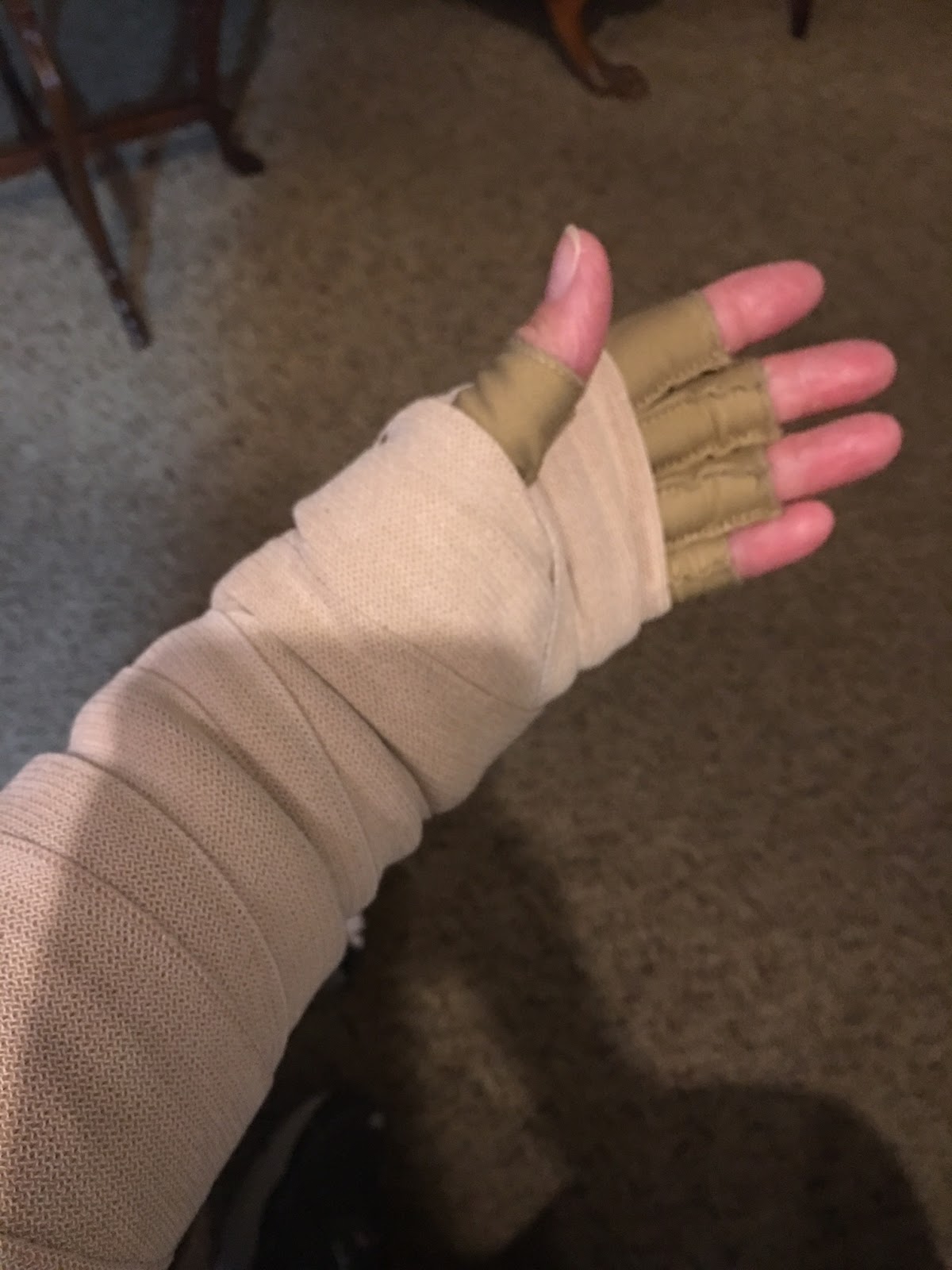
And thanks to a fortuitously timed cancellation I was able to take advantage of, my arm is now wrapped from shoulder to fingers to help clear out some swelling. It's unclear whether it is lymphedema (a known risk when lymph nodes are removed) or just post-operative swelling, but either way the therapist wants it out of there before I move on to radiation.  Hence the wrapping, plus some gentle stretches to do every two hours.


Thursday, November 2, 2017

Rhythm

There's a rhythm to my weeks now.  Today, for example, is Thursday, and that means it's Steroid Crash Day, aka What the Cat Dragged In Day.

You see, Monday is Infusion Day.  I spend a quiet morning at the cancer center, ensconced in a recliner reading or knitting or chatting, while the drugs drip into me through my port.  The process is completely painless.  The only discomfort is how cold the room is, and they supply heated blankets to take care of that.  My chemo drug, taxol, is an irritant, so the first thing they give me is a big slug of Benadryl, Pepcid, and a steroid, all to cushion the impact of the taxol.  That means that after my infusion I generally go home, eat lunch, and hit the sack to sleep off the Benadryl.

Then Tuesday and Wednesday are Steroid High Days: complete relief from all my random pre-cancer arthritic aches and pains, plus good energy--such good energy that I generally don't sleep through the night, waking up for good somewhere around 3:15 to 4:30 am.  But hey, who cares, I'm on a steroid high!

But by Thursday the steroid has worn off, and the piper must be paid for those missing nights of sleep.  Hence, Steroid Crash Day.  Don't expect much of me on Thursdays.

After that, the weekend days tend to be an alternation of pretty normal punctuated by random episodes of complete fatigue.  Nevertheless, I have been able to keep to my commitment of 35 minutes of vigorous cardio five days a week (Tuesday through Saturday).

All in all, the side effects I have experienced so far have been considerably milder than I feared, and certainly manageable, for which I am deeply grateful.  Food still tastes good, and I'm eating completely normally.  Well, higher protein than usual, because that's what they tell you to do during chemo.  I am not in pain. I have not had even the slightest touch of nausea.  Much to be thankful for!

AND, I'm now one-third the way through the chemo! Yay!