We met with the oncologist today and were given two treatment options to ponder. One is tried and true, shown to be very effective, but harder on the body. It would involve some heavy duty chemo before surgery, then lighter chemo after. The other option, available to me because of some specific characteristics of my tumor, would involve surgery first, then milder chemo after. He described it as probably just as effective, but can't say for sure because the two approaches have never been tested head to head.
We go back Aug 28 and presumably must announce a decision then. Please pray for me for wisdom and discernment as I ponder my choices.
On the lighter side: I love it that my treatment team consists of a woman surgeon, a male African immigrant nurse practitioner, and a male oncologist who was a nurse before he became a doctor. Take that, neo-Nazis and white supremacists!
Also on the lighter side: while we were driving down Patterson Blvd to the appointment this morning I saw an eagle dive down into the river, catch a fish, and fly away with it. First time I've seen such a thing--and within the city limits too! Felt like a blessing.
Friday, August 18, 2017

Wednesday, August 16, 2017
St. Raphael Archangel and the tiny angels
I've always resonated powerfully with images, whether visual or verbal. Maybe it's something innate about my personality; maybe it has to do with growing up Catholic, a culture rich in image and symbol. Probably both, and more.
I've loved poetry since I was a small child. Growing up, I used to haunt the National Gallery (we lived just outside of DC) and soak in the art. I still love art in all its forms, visual, verbal, and performed, and connect strongly with it on an intuitive, symbolic level.
So one more thing I've decided to do for myself, as I head into this passage through cancer treatment, is to harness the power of image and symbol on my behalf through visualization.
There's good science behind using visualization in pursuit of specific physical goals. Athletes can increase both skills and muscle strength with it (see here). And cancer patients are encouraged to use it for stress relief, to elevate mood, and even to improve immune system functioning, effects that have been scientifically verified (here and here).
So the question inevitably arises: visualize what? What images or symbols to use?
Many of you may be at least passingly familiar with the widespread cultural meme, "close your eyes and go to your happy place," but that's not what I'm looking for right now. I'm not looking for a place to escape to, but a way to engage with this journey.
When it comes to cancer, much of the imagery the popular culture offers for engagement strikes me as fundamentally violent: Kick cancer's butt! Let's appoint Biden to head a War on Cancer! You have to fight this! I can appreciate where these images are coming from, and if they work for you, fine. By all means, use them. But they don't quite feel like a fit for me. Fighting and violence are not what I find at the heart of the Gospel, and they are not what resonate within my soul. I need imagery that conveys that same element of bringing positive strength to bear, without the overtones of war or barroom brawl.
So I sent a request for appropriate imagery down to my inner self, and waited to see what would emerge.
The first thing that bubbled up was, "With their hands they will bear you up, lest you dash your foot against a stone."
That's Psalm 91. Here's the whole context, as I looked it up later (Psalm 91:1-12):
You who dwell in the shelter of the Most High,
who abide in the shadow of the Almighty,
say to the Lord, "My refuge and fortress,
my God in whom I trust."
He will rescue you from the fowler's snare,
from the destroying plague,
He will shelter you with his pinions,
and under his wings you may take refuge;
his faithfulness is a protecting shield.
You shall not fear the terror of the night
nor the arrow that flies by day,
Not the pestilence that roams in darkness,
not the plague that ravages at noon.
Though a thousand fall at your side,
ten thousand at your right hand,
near you it shall not come.
You need only watch;
the punishment of the wicked you will see.
Because you have the Lord for your refuge
and have made the Most High your stronghold,
no evil shall befall you,
no affliction come near your tent.
For he commands his angels with regard to you,
to guard you wherever you go.
With their hands they shall support you,
lest you strike your foot against a stone. (New American Bible Revised Version)
As I said, I looked up this full quote later, and loved what I found. Who wouldn't? So many wonderful images of God's strong protection. But in the moment, when just those last two lines popped into my head, an image popped in with them.
Angels. Tiny angels. Tiny microscopic cellular size or even molecular size angels, flowing all throughout my body, serving as focal points through which God's powerful protecting, healing, cleansing love could flow, directly into whatever areas in me needed it most.
I knew instantly that I had my visualization. Tiny angels.
I've never thought of angels as sort of fluffy celestial puppies, the way they are often depicted in popular culture (I blame the Renaissance artists, at least in part--all those fat little baby cherubs). Angels are powerful and scary! Or at least profoundly awe-inspiring. Otherwise, why would the first words out of their mouths in so many scriptural accounts be "Fear not!" or "Do not be afraid!"?
So in my visualization, I'm not seeing lots of celestial puppy dogs or Renaissance cherubs romping around inside me, but something more like lots of tiny firehoses directing God's love precisely where it's needed.
I was quite grateful and satisfied when this imagery emerged, and thought I had what I was looking for. But God, or my subconscious, or both, was not done yet.
The next morning I popped awake with another image: Raphael. Raphael as depicted in the Book of Tobit. Raphael, whose name means "God who heals."
The Book of Tobit is in Catholic and Orthodox bibles. Alas, it is not in Protestant bibles (sorry, guys--not my fault). Protestant bibles might include it in the Apocrypha. But anyway, here's a link to an intro to Tobit, which summarizes the story. And here's one to the story itself. It's a short read, and one I find delightful in its details. My bible app classifies it as a "Biblical novella," along with books like Jonah, Esther, and Judith. It tends to get grouped with the historical books, but probably really belongs with the wisdom literature. It is a symbolic tale conveying truths in an engaging form.
I'm not going to re-tell the whole story. You've got the links, read for yourself. But a few bits to explain Raphael and his role.
Tobit is a righteous man living in exile in Nineveh. Unlike many of his fellow Jews in exile, he really tries to keep the ways of his Jewish faith in this pagan context, even at considerable risk. Early in the story, he ends up blind and nearly destitute, but remembers that he has some money on deposit with a distant relative in far-away Media, so he decides to dispatch his only child, his son Tobiah, on a long and potentially dangerous journey to retrieve it. And the angel Raphael, in the guise of a young kinsman who knows the route to Media, shows up to be Tobiah's companion and guide.
It turns out to be an adventurous journey, and Raphael ends up serving as protector and healer as well as companion and guide. Footnote: both Tobit and Tobiah are variants of the same name, which means "God is good."
So: Raphael. Companion, guide, protector, healer. Sounds good to me! I'm happy to welcome Raphael into my visualization.
There's a lovely statue of Raphael by the front door of the Abuelo's in Beavercreek:

It's clear from what I've already told you why one of his attributes in art is a walking staff. To find out why he's carrying a big fish, you'll have to read the story. The above statue has helped to form in me a pleasant association between Raphael on the one hand and margaritas and guacamole on the other. Hey, at this point I'll take all the pleasant associations I can get!
Raphael accompanies, protects, and heals. All those tiny microscopic angels, whom I think of as Raphael's team, flow through my body, protecting, healing and cleansing (washing away the rubbish). I think this imagery will serve me well.
I even got a St. Raphael medal to wear, to serve as a touchstone to help me touch into this imagery whenever I feel like I need to.

You will notice that Raphael has his walking staff over his shoulder, but this time Tobiah is carrying the big fish. I like it that this is an image not just of Raphael but also of the act of accompaniment. It really helps to know that I am being accompanied on this journey. A big reason I am grateful for all of you.
I will post a quick update on Friday after we meet with the oncologist.

I've loved poetry since I was a small child. Growing up, I used to haunt the National Gallery (we lived just outside of DC) and soak in the art. I still love art in all its forms, visual, verbal, and performed, and connect strongly with it on an intuitive, symbolic level.
So one more thing I've decided to do for myself, as I head into this passage through cancer treatment, is to harness the power of image and symbol on my behalf through visualization.
There's good science behind using visualization in pursuit of specific physical goals. Athletes can increase both skills and muscle strength with it (see here). And cancer patients are encouraged to use it for stress relief, to elevate mood, and even to improve immune system functioning, effects that have been scientifically verified (here and here).
So the question inevitably arises: visualize what? What images or symbols to use?
Many of you may be at least passingly familiar with the widespread cultural meme, "close your eyes and go to your happy place," but that's not what I'm looking for right now. I'm not looking for a place to escape to, but a way to engage with this journey.
When it comes to cancer, much of the imagery the popular culture offers for engagement strikes me as fundamentally violent: Kick cancer's butt! Let's appoint Biden to head a War on Cancer! You have to fight this! I can appreciate where these images are coming from, and if they work for you, fine. By all means, use them. But they don't quite feel like a fit for me. Fighting and violence are not what I find at the heart of the Gospel, and they are not what resonate within my soul. I need imagery that conveys that same element of bringing positive strength to bear, without the overtones of war or barroom brawl.
So I sent a request for appropriate imagery down to my inner self, and waited to see what would emerge.
The first thing that bubbled up was, "With their hands they will bear you up, lest you dash your foot against a stone."
That's Psalm 91. Here's the whole context, as I looked it up later (Psalm 91:1-12):
You who dwell in the shelter of the Most High,
who abide in the shadow of the Almighty,
say to the Lord, "My refuge and fortress,
my God in whom I trust."
He will rescue you from the fowler's snare,
from the destroying plague,
He will shelter you with his pinions,
and under his wings you may take refuge;
his faithfulness is a protecting shield.
You shall not fear the terror of the night
nor the arrow that flies by day,
Not the pestilence that roams in darkness,
not the plague that ravages at noon.
Though a thousand fall at your side,
ten thousand at your right hand,
near you it shall not come.
You need only watch;
the punishment of the wicked you will see.
Because you have the Lord for your refuge
and have made the Most High your stronghold,
no evil shall befall you,
no affliction come near your tent.
For he commands his angels with regard to you,
to guard you wherever you go.
With their hands they shall support you,
lest you strike your foot against a stone. (New American Bible Revised Version)
As I said, I looked up this full quote later, and loved what I found. Who wouldn't? So many wonderful images of God's strong protection. But in the moment, when just those last two lines popped into my head, an image popped in with them.
Angels. Tiny angels. Tiny microscopic cellular size or even molecular size angels, flowing all throughout my body, serving as focal points through which God's powerful protecting, healing, cleansing love could flow, directly into whatever areas in me needed it most.
I knew instantly that I had my visualization. Tiny angels.
I've never thought of angels as sort of fluffy celestial puppies, the way they are often depicted in popular culture (I blame the Renaissance artists, at least in part--all those fat little baby cherubs). Angels are powerful and scary! Or at least profoundly awe-inspiring. Otherwise, why would the first words out of their mouths in so many scriptural accounts be "Fear not!" or "Do not be afraid!"?
So in my visualization, I'm not seeing lots of celestial puppy dogs or Renaissance cherubs romping around inside me, but something more like lots of tiny firehoses directing God's love precisely where it's needed.
I was quite grateful and satisfied when this imagery emerged, and thought I had what I was looking for. But God, or my subconscious, or both, was not done yet.
The next morning I popped awake with another image: Raphael. Raphael as depicted in the Book of Tobit. Raphael, whose name means "God who heals."
The Book of Tobit is in Catholic and Orthodox bibles. Alas, it is not in Protestant bibles (sorry, guys--not my fault). Protestant bibles might include it in the Apocrypha. But anyway, here's a link to an intro to Tobit, which summarizes the story. And here's one to the story itself. It's a short read, and one I find delightful in its details. My bible app classifies it as a "Biblical novella," along with books like Jonah, Esther, and Judith. It tends to get grouped with the historical books, but probably really belongs with the wisdom literature. It is a symbolic tale conveying truths in an engaging form.
I'm not going to re-tell the whole story. You've got the links, read for yourself. But a few bits to explain Raphael and his role.
Tobit is a righteous man living in exile in Nineveh. Unlike many of his fellow Jews in exile, he really tries to keep the ways of his Jewish faith in this pagan context, even at considerable risk. Early in the story, he ends up blind and nearly destitute, but remembers that he has some money on deposit with a distant relative in far-away Media, so he decides to dispatch his only child, his son Tobiah, on a long and potentially dangerous journey to retrieve it. And the angel Raphael, in the guise of a young kinsman who knows the route to Media, shows up to be Tobiah's companion and guide.
It turns out to be an adventurous journey, and Raphael ends up serving as protector and healer as well as companion and guide. Footnote: both Tobit and Tobiah are variants of the same name, which means "God is good."
So: Raphael. Companion, guide, protector, healer. Sounds good to me! I'm happy to welcome Raphael into my visualization.
There's a lovely statue of Raphael by the front door of the Abuelo's in Beavercreek:

It's clear from what I've already told you why one of his attributes in art is a walking staff. To find out why he's carrying a big fish, you'll have to read the story. The above statue has helped to form in me a pleasant association between Raphael on the one hand and margaritas and guacamole on the other. Hey, at this point I'll take all the pleasant associations I can get!
Raphael accompanies, protects, and heals. All those tiny microscopic angels, whom I think of as Raphael's team, flow through my body, protecting, healing and cleansing (washing away the rubbish). I think this imagery will serve me well.
I even got a St. Raphael medal to wear, to serve as a touchstone to help me touch into this imagery whenever I feel like I need to.

You will notice that Raphael has his walking staff over his shoulder, but this time Tobiah is carrying the big fish. I like it that this is an image not just of Raphael but also of the act of accompaniment. It really helps to know that I am being accompanied on this journey. A big reason I am grateful for all of you.
I will post a quick update on Friday after we meet with the oncologist.

Friday, August 11, 2017
Quick Update--Good News!
I just got the results from yesterday's biopsies, and the news is as good as it could possibly be. The area in the right breast is just fibrocystic changes, completely benign, of no further medical interest. And the lymph node in the left breast is cancer free. So from what we can know now, we are just dealing with one smallish mass in the left breast that hasn't had time to go anywhere else. Yay!
Hello again--I have news.
This blog has been dormant for a while, but I have decided to revive it. It will have a somewhat different focus.
For those of you who don't already know, I have breast cancer. (And don't feel too bad if you don't already know--I only found out a week ago.) We are still in the process of refining the diagnosis and designing the treatment plan. I'd like to use this blog to keep those who are interested updated, and to share whatever reflections occur to me as I move through this experience.
Right now, my intention is to try to post here weekly, or whenever there is significant news to share. If you want to follow along, here's the easiest way: Go to the full web version, not just what shows up on a mobile app. (If you are looking at this on a mobile app, you can scroll down to the bottom of the page and find a link for "View web version.") With the "Weird and Wonder-ful" web site up, look to the right, where the column with my profile appears, and scroll down a little. You will find a box for "Follow by Email." Enter your email address and hit Submit, and that's it. You should receive each new post in your email inbox whenever I update.
So. What do we know so far? There is a smallish but definitely cancerous mass in my left breast. It's a somewhat complicated form of cancer, in that it is rather aggressive but also has some characteristics that make it readily treatable. More about that when I know more.
I had two more biopsies yesterday, one on a lymph node on the left, where this cancer is, and one on an area of the right breast that looked odd on the mammogram. Awaiting results from those, which may begin to trickle in as soon as this afternoon (initial findings of cancer yes-or-no, but not yet the studies that show detailed characteristics of the cancer, if any).
Given what we know so far, it seems likely I will have some form of treatment with infused medicines for a while before I have surgery, and then again after. There is a medicine specific for the kind of cancer I have on the left which is not technically considered chemo (very specific to this particular kind of cell; far fewer side effects)--but I may have to have some chemo in addition. Don't know yet if/when radiation may be in the picture.
The earliest appointment I could get with the oncologist is next Friday, Aug. 18, a week from today. By then full results of the biopsies should be in hand and many questions about the course of treatment can be answered.
The surgeon initially had me scheduled for an operation to implant a port for infusing the meds this coming Tuesday, Aug. 15, but I freaked out a bit about that, since I won't have had my initial meeting with the oncologist until Friday the 18th. My internist agreed with me and contacted the oncologist, who contacted the surgeon. Result: procedure canceled for now, to be rescheduled if necessary (probably will be) after we get back from our trip to Jackson Hole to see the eclipse.
Yes, we are going to Jackson Hole to see the eclipse and play around a bit in Grand Teton and Yellowstone National Parks! Nick and Katey and their little girls Josie and Frances will be joining us. A week immersed in family and spectacular natural wonders seems like very good medicine to me, and all three docs are copacetic with it. So it's a go.
Reflections so far: Ladies, don't neglect your annual mammograms! Your risk only continues to rise with age, so you never outgrow the need for them. All this was detected on my regular annual mammo. And because I've had my mammos at the same place for years, we know that none of this was there last year.
As the initial shock has started to wear off, I've had a few good crying spells. I try to just let them happen when they want to. In between, I have really felt surprisingly calm (not to be confused with "completely calm"!). I've been mostly able to just stay in the present, living the experience hour by hour and day by day, without getting caught up in anticipation and dread. That has felt like a grace, a gift, and I am grateful.
I have had wonderful support from Michael, from friends, from my internist and the surgeon he referred me to, from the folks at the breast center who did yesterday's biopsies. I do feel cared for, and it helps immensely.
It occurred to me yesterday that one powerful thing I could do for myself would be to keep a feelings journal and commit to writing in it faithfully, as close to daily as possible. Fortunately, I had the perfect tool at hand. At just this time last year, Peter and Cynthia and Lucy and Henry gave me as a 70th birthday present a blank journal made by a crafter who sells them at the fabulous farmer's market in the park in Salt Lake City that we have visited with them. The journals are made from old books, with the vintage covers retained plus about twenty pages or so of the book, the rest being filled out with new blank journaling pages.
Mine is made from a 1935 hymnal called "Songs of Praise," published in Springfield, Missouri, though it's unclear what if any denomination it was published for. I know a few of the hymns in those opening pages, but most are new to me. Each of my sweeties inscribed the journal to me--wonderful, loving messages.
As I noted in my entry yesterday, I love it that my journal for this passage in my life is called "Songs of Praise." There is always some beauty offering itself to us, asking to be apprehended and absorbed. Therefore there are always grounds for praise. Always. No matter what.

For those of you who don't already know, I have breast cancer. (And don't feel too bad if you don't already know--I only found out a week ago.) We are still in the process of refining the diagnosis and designing the treatment plan. I'd like to use this blog to keep those who are interested updated, and to share whatever reflections occur to me as I move through this experience.
Right now, my intention is to try to post here weekly, or whenever there is significant news to share. If you want to follow along, here's the easiest way: Go to the full web version, not just what shows up on a mobile app. (If you are looking at this on a mobile app, you can scroll down to the bottom of the page and find a link for "View web version.") With the "Weird and Wonder-ful" web site up, look to the right, where the column with my profile appears, and scroll down a little. You will find a box for "Follow by Email." Enter your email address and hit Submit, and that's it. You should receive each new post in your email inbox whenever I update.
So. What do we know so far? There is a smallish but definitely cancerous mass in my left breast. It's a somewhat complicated form of cancer, in that it is rather aggressive but also has some characteristics that make it readily treatable. More about that when I know more.
I had two more biopsies yesterday, one on a lymph node on the left, where this cancer is, and one on an area of the right breast that looked odd on the mammogram. Awaiting results from those, which may begin to trickle in as soon as this afternoon (initial findings of cancer yes-or-no, but not yet the studies that show detailed characteristics of the cancer, if any).
Given what we know so far, it seems likely I will have some form of treatment with infused medicines for a while before I have surgery, and then again after. There is a medicine specific for the kind of cancer I have on the left which is not technically considered chemo (very specific to this particular kind of cell; far fewer side effects)--but I may have to have some chemo in addition. Don't know yet if/when radiation may be in the picture.
The earliest appointment I could get with the oncologist is next Friday, Aug. 18, a week from today. By then full results of the biopsies should be in hand and many questions about the course of treatment can be answered.
The surgeon initially had me scheduled for an operation to implant a port for infusing the meds this coming Tuesday, Aug. 15, but I freaked out a bit about that, since I won't have had my initial meeting with the oncologist until Friday the 18th. My internist agreed with me and contacted the oncologist, who contacted the surgeon. Result: procedure canceled for now, to be rescheduled if necessary (probably will be) after we get back from our trip to Jackson Hole to see the eclipse.
Yes, we are going to Jackson Hole to see the eclipse and play around a bit in Grand Teton and Yellowstone National Parks! Nick and Katey and their little girls Josie and Frances will be joining us. A week immersed in family and spectacular natural wonders seems like very good medicine to me, and all three docs are copacetic with it. So it's a go.
Reflections so far: Ladies, don't neglect your annual mammograms! Your risk only continues to rise with age, so you never outgrow the need for them. All this was detected on my regular annual mammo. And because I've had my mammos at the same place for years, we know that none of this was there last year.
As the initial shock has started to wear off, I've had a few good crying spells. I try to just let them happen when they want to. In between, I have really felt surprisingly calm (not to be confused with "completely calm"!). I've been mostly able to just stay in the present, living the experience hour by hour and day by day, without getting caught up in anticipation and dread. That has felt like a grace, a gift, and I am grateful.
I have had wonderful support from Michael, from friends, from my internist and the surgeon he referred me to, from the folks at the breast center who did yesterday's biopsies. I do feel cared for, and it helps immensely.
It occurred to me yesterday that one powerful thing I could do for myself would be to keep a feelings journal and commit to writing in it faithfully, as close to daily as possible. Fortunately, I had the perfect tool at hand. At just this time last year, Peter and Cynthia and Lucy and Henry gave me as a 70th birthday present a blank journal made by a crafter who sells them at the fabulous farmer's market in the park in Salt Lake City that we have visited with them. The journals are made from old books, with the vintage covers retained plus about twenty pages or so of the book, the rest being filled out with new blank journaling pages.
Mine is made from a 1935 hymnal called "Songs of Praise," published in Springfield, Missouri, though it's unclear what if any denomination it was published for. I know a few of the hymns in those opening pages, but most are new to me. Each of my sweeties inscribed the journal to me--wonderful, loving messages.
As I noted in my entry yesterday, I love it that my journal for this passage in my life is called "Songs of Praise." There is always some beauty offering itself to us, asking to be apprehended and absorbed. Therefore there are always grounds for praise. Always. No matter what.

Thursday, February 2, 2017
Knitting Into Beauty
I don't even remember now how I first learned about temperature blankets. I was fiddling around online on New Year's Eve and somehow stumbled upon them.
The idea is to knit a blanket, one row per day for a whole year, with each row's color determined by the high temperature of that day. Some people do low temp or temp at noon, but most seem to do high temp.
I was instantly enchanted with the idea, who knows why, and spent a delighted hour or so designing a temperature blanket project for myself and ordering ten colors of yarn, roughly tracking the spectrum from purple through violet, shades of blue, shades of green, yellow, and orange to red.
Then I had to wait, recording the daily high temperatures, until the yarn arrived and I could start knitting. It did arrive, and I did knit. Here is January in Dayton OH in my temperature blanket:
 There were two big surprises. First surprise: All that tweedy stuff! I was expecting stripes of color, but for the first three quarters of the month I was changing colors almost every row, as the temperatures bounced around rather wildly. Second surprise: All that green! Green represents a daily high temp from 54 to 66 degrees. In January. In Dayton OH. I definitely did not expect all that green!
So I expected stripes of purple, lavender, and shades of blue, and I got a lot of tweed heavily flecked with green.
It was a very interesting experience, knitting this way. I had set up certain parameters for the project--what colors for what temps, overall size--but I definitely felt that I was not in charge of the project. The blanket has a mind of its own, and it made some of the creative decisions.
Take stitch pattern, for example. I had thought to start out with a double moss stitch border, to prevent curling, then maybe switch to garter or stockinette with the moss stitch continuing only along the edges. But as I began to knit the wildly fluctuating temperatures January brought, the blanket suggested, by showing me how interesting the resultant tweed looked, that maybe I should just stick with the moss stitch for the whole thing. The blanket also pointed out that the moss stitch, unlike garter or stockinette, would show the color of each row equally on both of its sides.
So I took the blanket's suggestion and continued with the double moss stitch. I thought I might go nuts constantly switching between knit two and purl two, but since I'm only doing a row a day (or a max of three rows or so when I have to skip a day or two of knitting) the knit two purl two hasn't been the problem I feared.
Here's a closeup that shows the tweed:
 And here's one where you can sort of see the moss stitch texture, in the initial light blue stripe and the recent dark blue one:
 Incidentally, I discovered that there is absolutely no consensus in the online knitting community about the definition of moss stitch and double moss stitch. Some would call what I'm doing double moss stitch, but some would say that it's not, it's a very small two-stitch, two-row basketweave. Whatever. I like the image of moss, so I'm going to keep on thinking of it as double moss stitch.
A few reflections on how it has felt to be doing this project in this January of 2017:
I am not a fan of winter. I dislike cold weather, and the bleak colors and gray skies that go with it here in Dayton. I concede that falling snowflakes are pretty, but I dislike living with snow on the ground and intensely dislike ice.
But knitting this blanket has opened me to a different experience of this winter. Without surrendering my dislike of cold and snow and ice, I am at the same time acknowledging and making visible the beauty of this winter season. I have found myself resenting all that green ("You'll have your chance come spring! Back off!"), and wishing I could put in some more lavender and purple, even while, on another level, enjoying the aberrant mildness as I go out and about.
I have also found myself acutely aware of climate change and its very real dangers--another factor in resenting the green rows.
The blanket makes beauty out of all these complicated and somewhat contradictory experiences and reactions.
Coincidentally, our theology book group has just started John O'Donohue's book Beauty:
 On p. 5 O'Donohue says, "Our times are driven by the inestimable energies of the mechanical mind; its achievements derive from its singular focus, linear direction, and force. When it dominates, the habit of gentleness dies out. We become blind: nature is rifled, politics eschews vision and becomes the obsessive servant of economics, and religion opts for the mathematics of system and forgets its mystical force."
Knitting this blanket is an exercise in gentleness: waiting patiently for the next row-color to be revealed, waiting patiently for the pattern to emerge, not imposing my patterns and preferences but receiving and responding to what comes forth. It's a more gentle way of knitting, an icon of a more gentle way of engaging with the world.
At the same time, it is active, not passive: my act of knitting makes visible, asserts. Especially in this highly changeable January of 2017, when a sense of pattern could easily have been lost in all the fluctuations, my knitting asserts, "Here! This is our January!"
On p. 6 of his book, O'Donohue goes on to say, "Our struggle for reform needs to be tempered and balanced with a capacity for celebration. When we lose sight of beauty our struggle becomes tired and functional. When we expect and engage the Beautiful....[t]he heart becomes rekindled and our lives brighten with unexpected courage."
In other words: Find the beauty in our experience, and we find both endurance and courage.
A powerful message, in that January that saw Trump's inauguration and the tumultuous first twelve days of his presidency. Find beauty. Find a way to assert it, to set it forth for others to see as well. And you will in doing so find courage (cor, heart, hence heart-strength) and endurance. This blanket project, unexpectedly, has been doing this for me, at least in a small way. What's doing it for you?
ADDENDUM:
If you want to try your hand at a temperature blanket, here's the recipe I followed:
Lion Brand Vanna's Choice yarn (from Amazon) (worsted weight)
Size 10 circular needle with 47 inch cable
Cast on 200 stitches (will make a lap afghan approximately 50 x 60 ins)
(If you want to make a scarf instead, cast on 30 stitches--will make a scarf approximately 8 x 60 ins)
Continue with what some would call double moss stitch, some a tiny basket weave: k2 p2 across, next row continue in stockinette like pattern (knit the knits, purl the purls), third row purl the knits and knit the purls, fourth row knit the knits and purl the purls. So a 2-stitch, 2-row basket weave (every other row you reverse).
Note: "knit the knits" = if the stitch facing you is coming up onto the needle through a smooth loop, knit it; "purl the purls" = if the stitch on the needle has a purl bump facing you just below it, purl it.
Ten colors:
Below 0: purple
1-21: electric purple
21-32: periwinkle
33-43: sapphire
44-53: sky blue
54-66: Kelly green
67-77: fern
78-88: lemon
89-99: terra-cotta
Over 100: scarlet
You can check out either Amazon or the Lion Brand website under Vanna's Choice to pick your own colors if you want.
I'm going by the high temperature for the day; some use the low. When I'm home, I just watch my thermometer and record the high. If not home, this website will give it:
Weather Underground historic temperatures
I record the temp on the days of a small calendar, where I also note what color I need to do that row in and whether I need to reverse the pattern on that row (it's not that easy to read the stitches with all the color changes). Then I put a check mark in the calendar box when I have actually knitted the row, because sometimes it's a day or two before I get to it.
USE THE RUSSIAN JOIN!! Or you will go crazy with all those ends to weave in at the end. Also, the Russian join gives a clear, sharp break between colors. Tip: place a paper clip on the yarn right where it comes out of the last stitch on your row. Then rip back six stitches, and when you are making your loop in that yarn, insert your needle into the yarn right where your paper clip is. When you have finished making your join, re-knit the six stitches you ripped and then continue with your new row. This will ensure that the yarn color change happens right at the edge of the piece.
Russian Join Instructions
Some internet comments indicated that the 365 rows can make for a very long blanket, so I did not do any border, and in fact counted my long-tail cast-on row as the Jan 1 row. Likewise I plan to count my cast-off row as Dec 31. My 200 st width makes a comfortable lap afghan.
Variation: Using the Weather Underground website link above, you can reconstruct temperature data for any year you want (in the USA). So you could make blankets or scarves for a birth year, an anniversary year, a graduation year, or whatever other milestone year you want to commemorate. And you wouldn't have to start with January 1; you could do first year of life, starting on the birthday, or first year of marriage, starting on the wedding day, or whatever. But starting on January 1 does give your color scheme a certain rough symmetry, starting with cooler colors, going to warmer ones, then back to cooler.
Also note: your temperature range color chart needs to reflect your location. The one above was originally constructed for New York City, but I figured it would work just as well for Dayton OH. Our climate is not that different from New York. You need to figure out what your likely lowest and highest temps would be, then divide up the intervening degrees into chunks that allow for however many colors you want to use. The intervals above are roughly 10-12 degree chunks. If your climate range is narrower, you might want to use smaller chunks, say 5-7 degrees, to make your project more colorful.
The idea is to knit a blanket, one row per day for a whole year, with each row's color determined by the high temperature of that day. Some people do low temp or temp at noon, but most seem to do high temp.
I was instantly enchanted with the idea, who knows why, and spent a delighted hour or so designing a temperature blanket project for myself and ordering ten colors of yarn, roughly tracking the spectrum from purple through violet, shades of blue, shades of green, yellow, and orange to red.
Then I had to wait, recording the daily high temperatures, until the yarn arrived and I could start knitting. It did arrive, and I did knit. Here is January in Dayton OH in my temperature blanket:

So I expected stripes of purple, lavender, and shades of blue, and I got a lot of tweed heavily flecked with green.
It was a very interesting experience, knitting this way. I had set up certain parameters for the project--what colors for what temps, overall size--but I definitely felt that I was not in charge of the project. The blanket has a mind of its own, and it made some of the creative decisions.
Take stitch pattern, for example. I had thought to start out with a double moss stitch border, to prevent curling, then maybe switch to garter or stockinette with the moss stitch continuing only along the edges. But as I began to knit the wildly fluctuating temperatures January brought, the blanket suggested, by showing me how interesting the resultant tweed looked, that maybe I should just stick with the moss stitch for the whole thing. The blanket also pointed out that the moss stitch, unlike garter or stockinette, would show the color of each row equally on both of its sides.
So I took the blanket's suggestion and continued with the double moss stitch. I thought I might go nuts constantly switching between knit two and purl two, but since I'm only doing a row a day (or a max of three rows or so when I have to skip a day or two of knitting) the knit two purl two hasn't been the problem I feared.
Here's a closeup that shows the tweed:


A few reflections on how it has felt to be doing this project in this January of 2017:
I am not a fan of winter. I dislike cold weather, and the bleak colors and gray skies that go with it here in Dayton. I concede that falling snowflakes are pretty, but I dislike living with snow on the ground and intensely dislike ice.
But knitting this blanket has opened me to a different experience of this winter. Without surrendering my dislike of cold and snow and ice, I am at the same time acknowledging and making visible the beauty of this winter season. I have found myself resenting all that green ("You'll have your chance come spring! Back off!"), and wishing I could put in some more lavender and purple, even while, on another level, enjoying the aberrant mildness as I go out and about.
I have also found myself acutely aware of climate change and its very real dangers--another factor in resenting the green rows.
The blanket makes beauty out of all these complicated and somewhat contradictory experiences and reactions.
Coincidentally, our theology book group has just started John O'Donohue's book Beauty:

Knitting this blanket is an exercise in gentleness: waiting patiently for the next row-color to be revealed, waiting patiently for the pattern to emerge, not imposing my patterns and preferences but receiving and responding to what comes forth. It's a more gentle way of knitting, an icon of a more gentle way of engaging with the world.
At the same time, it is active, not passive: my act of knitting makes visible, asserts. Especially in this highly changeable January of 2017, when a sense of pattern could easily have been lost in all the fluctuations, my knitting asserts, "Here! This is our January!"
On p. 6 of his book, O'Donohue goes on to say, "Our struggle for reform needs to be tempered and balanced with a capacity for celebration. When we lose sight of beauty our struggle becomes tired and functional. When we expect and engage the Beautiful....[t]he heart becomes rekindled and our lives brighten with unexpected courage."
In other words: Find the beauty in our experience, and we find both endurance and courage.
A powerful message, in that January that saw Trump's inauguration and the tumultuous first twelve days of his presidency. Find beauty. Find a way to assert it, to set it forth for others to see as well. And you will in doing so find courage (cor, heart, hence heart-strength) and endurance. This blanket project, unexpectedly, has been doing this for me, at least in a small way. What's doing it for you?
ADDENDUM:
If you want to try your hand at a temperature blanket, here's the recipe I followed:
Lion Brand Vanna's Choice yarn (from Amazon) (worsted weight)
Size 10 circular needle with 47 inch cable
Cast on 200 stitches (will make a lap afghan approximately 50 x 60 ins)
(If you want to make a scarf instead, cast on 30 stitches--will make a scarf approximately 8 x 60 ins)
Continue with what some would call double moss stitch, some a tiny basket weave: k2 p2 across, next row continue in stockinette like pattern (knit the knits, purl the purls), third row purl the knits and knit the purls, fourth row knit the knits and purl the purls. So a 2-stitch, 2-row basket weave (every other row you reverse).
Note: "knit the knits" = if the stitch facing you is coming up onto the needle through a smooth loop, knit it; "purl the purls" = if the stitch on the needle has a purl bump facing you just below it, purl it.
Ten colors:
Below 0: purple
1-21: electric purple
21-32: periwinkle
33-43: sapphire
44-53: sky blue
54-66: Kelly green
67-77: fern
78-88: lemon
89-99: terra-cotta
Over 100: scarlet
You can check out either Amazon or the Lion Brand website under Vanna's Choice to pick your own colors if you want.
I'm going by the high temperature for the day; some use the low. When I'm home, I just watch my thermometer and record the high. If not home, this website will give it:
Weather Underground historic temperatures
I record the temp on the days of a small calendar, where I also note what color I need to do that row in and whether I need to reverse the pattern on that row (it's not that easy to read the stitches with all the color changes). Then I put a check mark in the calendar box when I have actually knitted the row, because sometimes it's a day or two before I get to it.
USE THE RUSSIAN JOIN!! Or you will go crazy with all those ends to weave in at the end. Also, the Russian join gives a clear, sharp break between colors. Tip: place a paper clip on the yarn right where it comes out of the last stitch on your row. Then rip back six stitches, and when you are making your loop in that yarn, insert your needle into the yarn right where your paper clip is. When you have finished making your join, re-knit the six stitches you ripped and then continue with your new row. This will ensure that the yarn color change happens right at the edge of the piece.
Russian Join Instructions
Some internet comments indicated that the 365 rows can make for a very long blanket, so I did not do any border, and in fact counted my long-tail cast-on row as the Jan 1 row. Likewise I plan to count my cast-off row as Dec 31. My 200 st width makes a comfortable lap afghan.
Variation: Using the Weather Underground website link above, you can reconstruct temperature data for any year you want (in the USA). So you could make blankets or scarves for a birth year, an anniversary year, a graduation year, or whatever other milestone year you want to commemorate. And you wouldn't have to start with January 1; you could do first year of life, starting on the birthday, or first year of marriage, starting on the wedding day, or whatever. But starting on January 1 does give your color scheme a certain rough symmetry, starting with cooler colors, going to warmer ones, then back to cooler.
Also note: your temperature range color chart needs to reflect your location. The one above was originally constructed for New York City, but I figured it would work just as well for Dayton OH. Our climate is not that different from New York. You need to figure out what your likely lowest and highest temps would be, then divide up the intervening degrees into chunks that allow for however many colors you want to use. The intervals above are roughly 10-12 degree chunks. If your climate range is narrower, you might want to use smaller chunks, say 5-7 degrees, to make your project more colorful.
Friday, January 16, 2015
A Rapture of Clouds
"The sky is the daily bread of the eyes." --Ralph Waldo Emerson
A couple of weeks ago, someone I don't know commenting on somebody else's Facebook post mentioned being a member of the Cloud Appreciation Society.
Cloud Appreciation Society?? Something within me perked up. There's really a Cloud Appreciation Society? I must know more....
I have resonated to clouds and sky for a long long time. It was in my early elementary school years, when the nuns were busily teaching me all the traditional images for God (Shepherd, King, Jesus, Father) that I named for myself a unique personal image of God: an overcast sky of textured gray clouds, which spoke to my young self of a God who tucked me and the whole world in safe and warm, like the blankets that tucked me into my bed at night.
And from that point on, whenever I took note of the clouds in the sky, it was like a little quick moment of touching base with God--a God as vast and varied and ever-present as the sky and its clouds.
So of course I had to find out about the Cloud Appreciation Society.
And it turns out there really is such a thing! There's a website (here), and for a modest one-time fee you can become a lifetime member.
The founder, Gavin Pretor-Pinney, speaks charmingly of "fighting the banality of 'blue-sky' thinking" and not being ashamed to own up to loving the clouds that others moan about. He's got a wonderful manifesto that ends with a resounding call to "Look up, marvel at the ephemeral beauty, and live life with your head in the clouds!"
There's an online Cloud Shop at the website where you can purchase Society memberships, cloud-themed objects, and Pretor-Pinney's two books, The Cloud Collector's Handbook and The Cloudspotter's Guide. I've started the first one and am finding it full of information, wit, and whimsy.
The Society also exists as a Facebook group, which I of course immediately asked to join.
So for the past couple of weeks, my Facebook feed has been full of pictures of clouds posted by Society members all over the world. Regular post-ers include people in England, Italy, Croatia, Finland, Australia, Brazil, Spain, Scotland, and Nepal. And some members appear to be pilots, because we often get pix of the clouds taken from above.
It's amazing how gently but powerfully I am affected by seeing these posts regularly. My sense of who I am and where I live is steadily, softly, inexorably expanding.
This morning, as I sat in the early morning dark sipping my coffee and checking Facebook, I was met with pictures of glorious sunsets from Australia and Nepal, and brilliant noonday clouds from England. So of course I had to set down my coffee and go outside to photograph the delicate wispy-pink dawn clouds of Ohio to post.
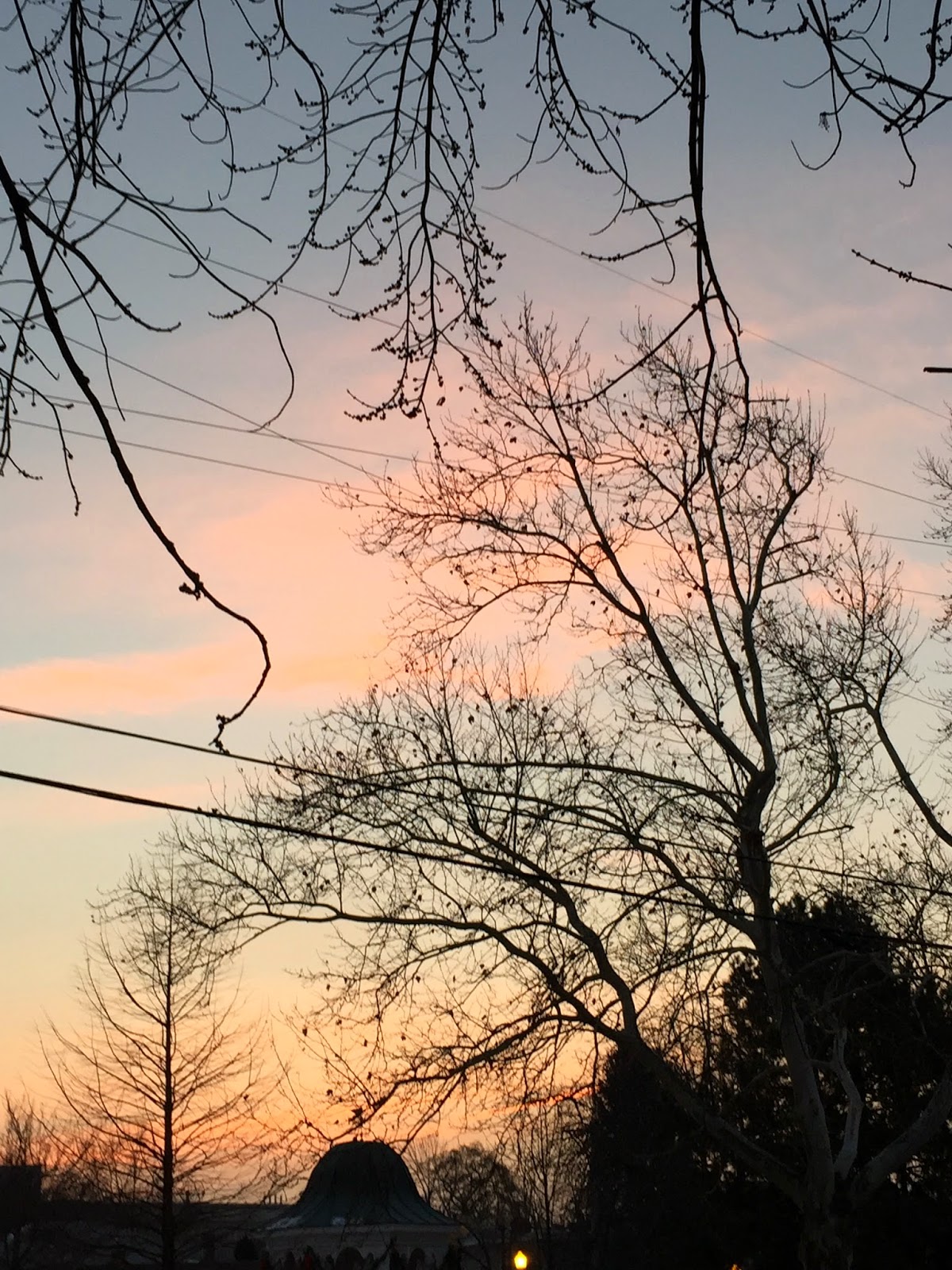
My sense of who I am and where I live feels different. It's not the content of it that has changed, but the experience of it. I no longer feel myself living only here in Dayton OH, but rather on a whole turning planet. It's winter where I'm posting from, and in England and Finland and Croatia, but I'm also absorbing posts of the rich summer currently bathing Australia and Brazil. If it's breakfast time where I am, I am taking in images of noonday or sunset somewhere else. Before I go to bed, I may even be seeing images of tomorrow's dawn.
I can feel this expansion of self and sense of place happening through the common bond of gazing with wonder and appreciation at the sky and the clouds. In place of the abstract concept of "one world, one human family," I now experience one shared delight in the different moods of the sky and clouds happening simultaneously around the planet in human hearts everywhere that enjoy it as much as I do.
It's quite lovely. A completely unexpected blessing.
A couple of weeks ago, someone I don't know commenting on somebody else's Facebook post mentioned being a member of the Cloud Appreciation Society.
Cloud Appreciation Society?? Something within me perked up. There's really a Cloud Appreciation Society? I must know more....
I have resonated to clouds and sky for a long long time. It was in my early elementary school years, when the nuns were busily teaching me all the traditional images for God (Shepherd, King, Jesus, Father) that I named for myself a unique personal image of God: an overcast sky of textured gray clouds, which spoke to my young self of a God who tucked me and the whole world in safe and warm, like the blankets that tucked me into my bed at night.
And from that point on, whenever I took note of the clouds in the sky, it was like a little quick moment of touching base with God--a God as vast and varied and ever-present as the sky and its clouds.
So of course I had to find out about the Cloud Appreciation Society.
And it turns out there really is such a thing! There's a website (here), and for a modest one-time fee you can become a lifetime member.
The founder, Gavin Pretor-Pinney, speaks charmingly of "fighting the banality of 'blue-sky' thinking" and not being ashamed to own up to loving the clouds that others moan about. He's got a wonderful manifesto that ends with a resounding call to "Look up, marvel at the ephemeral beauty, and live life with your head in the clouds!"
There's an online Cloud Shop at the website where you can purchase Society memberships, cloud-themed objects, and Pretor-Pinney's two books, The Cloud Collector's Handbook and The Cloudspotter's Guide. I've started the first one and am finding it full of information, wit, and whimsy.
The Society also exists as a Facebook group, which I of course immediately asked to join.
So for the past couple of weeks, my Facebook feed has been full of pictures of clouds posted by Society members all over the world. Regular post-ers include people in England, Italy, Croatia, Finland, Australia, Brazil, Spain, Scotland, and Nepal. And some members appear to be pilots, because we often get pix of the clouds taken from above.
It's amazing how gently but powerfully I am affected by seeing these posts regularly. My sense of who I am and where I live is steadily, softly, inexorably expanding.
This morning, as I sat in the early morning dark sipping my coffee and checking Facebook, I was met with pictures of glorious sunsets from Australia and Nepal, and brilliant noonday clouds from England. So of course I had to set down my coffee and go outside to photograph the delicate wispy-pink dawn clouds of Ohio to post.
My sense of who I am and where I live feels different. It's not the content of it that has changed, but the experience of it. I no longer feel myself living only here in Dayton OH, but rather on a whole turning planet. It's winter where I'm posting from, and in England and Finland and Croatia, but I'm also absorbing posts of the rich summer currently bathing Australia and Brazil. If it's breakfast time where I am, I am taking in images of noonday or sunset somewhere else. Before I go to bed, I may even be seeing images of tomorrow's dawn.
I can feel this expansion of self and sense of place happening through the common bond of gazing with wonder and appreciation at the sky and the clouds. In place of the abstract concept of "one world, one human family," I now experience one shared delight in the different moods of the sky and clouds happening simultaneously around the planet in human hearts everywhere that enjoy it as much as I do.
It's quite lovely. A completely unexpected blessing.
Monday, September 1, 2014
Mushrooms and Monguette
Plants are amazing. They have the power to take up inert, non-living elements like minerals from rock dissolved in water, combine them with energy captured directly from sunlight, and assemble them into living/growing/ever-changing structures of great beauty and complexity. Poetically speaking, animals are just parasites, living off the hard work of plants, either directly by eating them or indirectly by eating other animals that ate plants. But it's plants that work the transformative magic, from non-life to life.
That, at least, is the rather simplified picture of the natural world that reflects the state of biological understanding I grew up with in the 1950s, before ecology and genetics came into their own in scientific circles. Now of course we know that it's actually a lot more complicated.
Consider fungi, for example. Scientists now classify them as neither plants nor animals, but instead as living beings comprising an entirely separate kingdom in biological taxonomy. And their work is the opposite of plants. They are the decomposers, life forms that take apart the structures plants and animals create. And they are just as essential to a healthy ecosystem as the plants who bring life out of non-life. They too--the decomposers--wield the power of transformation. By disassembling the complex structures of no longer living plants and animals, they make the elements bound into those now-dead structures available again to be incorporated into new and different living beings. Sauteed mushrooms, anyone?
So what prompted these musings? Quick answer: two occurrences in the garden, plus the fact that today is Labor Day.
The garden first. About a week and a half ago, I took this picture of Mongo:


That, at least, is the rather simplified picture of the natural world that reflects the state of biological understanding I grew up with in the 1950s, before ecology and genetics came into their own in scientific circles. Now of course we know that it's actually a lot more complicated.
Consider fungi, for example. Scientists now classify them as neither plants nor animals, but instead as living beings comprising an entirely separate kingdom in biological taxonomy. And their work is the opposite of plants. They are the decomposers, life forms that take apart the structures plants and animals create. And they are just as essential to a healthy ecosystem as the plants who bring life out of non-life. They too--the decomposers--wield the power of transformation. By disassembling the complex structures of no longer living plants and animals, they make the elements bound into those now-dead structures available again to be incorporated into new and different living beings. Sauteed mushrooms, anyone?
So what prompted these musings? Quick answer: two occurrences in the garden, plus the fact that today is Labor Day.
The garden first. About a week and a half ago, I took this picture of Mongo:
Never having been a foster-mother to a pumpkin before, I wasn't sure, but that really looked to me like a pumpkin approaching harvest time. So the next day (last Tuesday), I seized the opportunity to consult with Emily of Mile Creek Farm (we are the downtown pickup point for their CSA). She said that yes indeed, Mongo was now harvestable, and their practice was to go ahead and harvest, not leave things sitting around. By that time, Mongo looked like this:
If you look closely at this picture, you will notice that by then Mongo's warts had turned entirely orange, and that I followed Emily's advice and cut Mongo's stem from the vine. Mongo is now adorning our kitchen table, along with some of Emily's sunflowers:
I'm pretty sure it was Thursday when I cut Mongo's stem, Friday when I brought him inside, and Saturday when I washed him off and gave him the place of honor on the table. Sunday--yesterday--we had a good soaking rain for several hours, very welcome, as the garden had gotten quite dry. Sunday afternoon, on impulse, I checked the pumpkin vine, and what do you suppose I found?
Mongo has a sibling! That little green bulbous swelling at the base of the flower is exactly what Mongo looked like at the same age. Since it is impossible to determine the gender of a pumpkin, and since Mongo sounds to me like a boy's name, I have arbitrarily decided to balance things out and designate this one a girl. I'm calling her Monguette, the French feminine form of Mongo. Now it's a race against time. Today is already September 1--will there be enough growing season left for Monguette to ripen? We'll see. Even if she doesn't ripen fully, I bet there will be enough time for her to become an excellent Halloween decoration.
The arrival of Monguette is the first of the two garden occurrences I referred to above. The second happened this morning. As I mentioned, yesterday we had a good soaking rain. This morning when I went out to retrieve the newspaper, here is what I saw:
So lovely, so delicate, these little decomposers that sprang up overnight! Look in that second picture, how they seem to be embracing my birthday rock.
So here I am on Labor Day, the first Labor Day of my retirement, reflecting on mushrooms and Monguette. My birthday rock, symbol of my life so far, embraced by lovely decomposers. One structure of my life, the formal work of spirituality ministry, is over. Now it's time for the lovely decomposers to embrace that dead structure, disassemble it, and make its elements available for reassembly into something new and full of life--something perhaps as unexpected, untamed, and vigorous as the vine that gave me Mongo and Monguette. Will there be enough time for whatever fruit comes to ripen fully? Who knows? But I bet there will be enough time for it to be a blessing in some way.
My job is to welcome both the embrace of the decomposers and the wild unruly new sprouts. It's a different kind of labor, but well worth celebrating on this Labor Day.
Subscribe to:
Posts (Atom)