Thursday, February 2, 2017

Knitting Into Beauty

I don't even remember now how I first learned about temperature blankets.  I was fiddling around online on New Year's Eve and somehow stumbled upon them.

The idea is to knit a blanket, one row per day for a whole year, with each row's color determined by the high temperature of that day.  Some people do low temp or temp at noon, but most seem to do high temp.

I was instantly enchanted with the idea, who knows why, and spent a delighted hour or so designing a temperature blanket project for myself and ordering ten colors of yarn, roughly tracking the spectrum from purple through violet, shades of blue, shades of green, yellow, and orange to red.

Then I had to wait, recording the daily high temperatures, until the yarn arrived and I could start knitting.  It did arrive, and I did knit.  Here is January in Dayton OH in my temperature blanket:

There were two big surprises. First surprise:  All that tweedy stuff!  I was expecting stripes of color, but for the first three quarters of the month I was changing colors almost every row, as the temperatures bounced around rather wildly.  Second surprise: All that green!  Green represents a daily high temp from 54 to 66 degrees.  In January. In Dayton OH.  I definitely did not expect all that green!

So I expected stripes of purple, lavender, and shades of blue, and I got a lot of tweed heavily flecked with green.

It was a very interesting experience, knitting this way.  I had set up certain parameters for the project--what colors for what temps, overall size--but I definitely felt that I was not in charge of the project.  The blanket has a mind of its own, and it made some of the creative decisions.

Take stitch pattern, for example.  I had thought to start out with a double moss stitch border, to prevent curling, then maybe switch to garter or stockinette with the moss stitch continuing only along the edges.  But as I began to knit the wildly fluctuating temperatures January brought, the blanket suggested, by showing me how interesting the resultant tweed looked, that maybe I should just stick with the moss stitch for the whole thing.  The blanket also pointed out that the moss stitch, unlike garter or stockinette, would show the color of each row equally on both of its sides.

So I took the blanket's suggestion and continued with the double moss stitch.  I thought I might go nuts constantly switching between knit two and purl two, but since I'm only doing a row a day (or a max of three rows or so when I have to skip a day or two of knitting) the knit two purl two hasn't been the problem I feared.

Here's a closeup that shows the tweed:

And here's one where you can sort of see the moss stitch texture, in the initial light blue stripe and the recent dark blue one:

Incidentally, I discovered that there is absolutely no consensus in the online knitting community about the definition of moss stitch and double moss stitch.  Some would call what I'm doing double moss stitch, but some would say that it's not, it's a very small two-stitch, two-row basketweave.  Whatever.  I like the image of moss, so I'm going to keep on thinking of it as double moss stitch.

A few reflections on how it has felt to be doing this project in this January of 2017:

I am not a fan of winter.  I dislike cold weather, and the bleak colors and gray skies that go with it here in Dayton.  I concede that falling snowflakes are pretty, but I dislike living with snow on the ground and intensely dislike ice.

But knitting this blanket has opened me to a different experience of this winter.  Without surrendering my dislike of cold and snow and ice, I am at the same time acknowledging and making visible the beauty of this winter season.  I have found myself resenting all that green ("You'll have your chance come spring! Back off!"), and wishing I could put in some more lavender and purple, even while, on another level, enjoying the aberrant mildness as I go out and about.

I have also found myself acutely aware of climate change and its very real dangers--another factor in resenting the green rows.

The blanket makes beauty out of all these complicated and somewhat contradictory experiences and reactions.

Coincidentally, our theology book group has just started John O'Donohue's book Beauty:

On p. 5 O'Donohue says, "Our times are driven by the inestimable energies of the mechanical mind; its achievements derive from its singular focus, linear direction, and force.  When it dominates, the habit of gentleness dies out. We become blind: nature is rifled, politics eschews vision and becomes the obsessive servant of economics, and religion opts for the mathematics of system and forgets its mystical force."

Knitting this blanket is an exercise in gentleness: waiting patiently for the next row-color to be revealed, waiting patiently for the pattern to emerge, not imposing my patterns and preferences but receiving and responding to what comes forth.  It's a more gentle way of knitting, an icon of a more gentle way of engaging with the world.

At the same time, it is active, not passive: my act of knitting makes visible, asserts.  Especially in this highly changeable January of 2017, when a sense of pattern could easily have been lost in all the fluctuations, my knitting asserts, "Here! This is our January!"

On p. 6 of his book, O'Donohue goes on to say, "Our struggle for reform needs to be tempered and balanced with a capacity for celebration.  When we lose sight of beauty our struggle  becomes tired and functional.  When we expect and engage the Beautiful....[t]he heart becomes rekindled and our lives brighten with unexpected courage."

In other words: Find the beauty in our experience, and we find both endurance and courage.

A powerful message, in that January that saw Trump's inauguration and the tumultuous first twelve days of his presidency.  Find beauty.  Find a way to assert it, to set it forth for others to see as well.  And you will in doing so find courage (cor, heart, hence heart-strength) and endurance.  This blanket project, unexpectedly, has been doing this for me, at least in a small way.  What's doing it for you?


ADDENDUM:
If you want to try your hand at a temperature blanket, here's the recipe I followed:

Lion Brand Vanna's Choice yarn (from Amazon) (worsted weight)

Size 10 circular needle with 47 inch cable

Cast on 200 stitches (will make a lap afghan approximately 50 x 60 ins)

(If you want to make a scarf instead, cast on 30 stitches--will make a scarf approximately 8 x 60 ins)

Continue with what some would call double moss stitch, some a tiny basket weave: k2 p2 across, next row continue in stockinette like pattern (knit the knits, purl the purls), third row purl the knits and knit the purls, fourth row knit the knits and purl the purls. So a 2-stitch, 2-row basket weave (every other row you reverse). 

Note: "knit the knits" = if the stitch facing you is coming up onto the needle through a smooth loop, knit it; "purl the purls" = if the stitch on the needle has a purl bump facing you just below it, purl it. 

Ten colors:
Below 0: purple
1-21: electric purple
21-32: periwinkle
33-43: sapphire
44-53: sky blue
54-66: Kelly green
67-77: fern
78-88: lemon
89-99: terra-cotta
Over 100: scarlet

You can check out either Amazon or the Lion Brand website under Vanna's Choice to pick your own colors if you want.

I'm going by the high temperature for the day; some use the low. When I'm home, I just watch my thermometer and record the high. If not home, this website will give it:
Weather Underground historic temperatures


I record the temp on the days of a small calendar, where I also note what color I need to do that row in and whether I need to reverse the pattern on that row (it's not that easy to read the stitches with all the color changes). Then I put a check mark in the calendar box when I have actually knitted the row, because sometimes it's a day or two before I get to it.

USE THE RUSSIAN JOIN!! Or you will go crazy with all those ends to weave in at the end. Also, the Russian join gives a clear, sharp break between colors. Tip: place a paper clip on the yarn right where it comes out of the last stitch on your row. Then rip back six stitches, and when you are making your loop in that yarn, insert your needle into the yarn right where your paper clip is. When you have finished making your join, re-knit the six stitches you ripped and then continue with your new row. This will ensure that the yarn color change happens right at the edge of the piece.
Russian Join Instructions

Some internet comments indicated that the 365 rows can make for a very long blanket, so I did not do any border, and in fact counted my long-tail cast-on row as the Jan 1 row. Likewise I plan to count my cast-off row as Dec 31. My 200 st width makes a comfortable lap afghan.

Variation: Using the Weather Underground website link above, you can reconstruct temperature data for any year you want (in the USA). So you could make blankets or scarves for a birth year, an anniversary year, a graduation year, or whatever other milestone year you want to commemorate. And you wouldn't have to start with January 1; you could do first year of life, starting on the birthday, or first year of marriage, starting on the wedding day, or whatever. But starting on January 1 does give your color scheme a certain rough symmetry, starting with cooler colors, going to warmer ones, then back to cooler.

Also note: your temperature range color chart needs to reflect your location. The one above was originally constructed for New York City, but I figured it would work just as well for Dayton OH. Our climate is not that different from New York. You need to figure out what your likely lowest and highest temps would be, then divide up the intervening degrees into chunks that allow for however many colors you want to use. The intervals above are roughly 10-12 degree chunks. If your climate range is narrower, you might want to use smaller chunks, say 5-7 degrees, to make your project more colorful.


Friday, January 16, 2015

A Rapture of Clouds

"The sky is the daily bread of the eyes."  --Ralph Waldo Emerson

A couple of weeks ago, someone I don't know commenting on somebody else's Facebook post mentioned being a member of the Cloud Appreciation Society.

Cloud Appreciation Society?? Something within me perked up.  There's really a Cloud Appreciation Society? I must know more....

I have resonated to clouds and sky for a long long time. It was in my early elementary school years, when the nuns were busily teaching me all the traditional images for God (Shepherd, King, Jesus, Father) that I named for myself a unique personal image of God: an overcast sky of textured gray clouds, which spoke to my young self of a God who tucked me and the whole world in safe and warm, like the blankets that tucked me into my bed at night.

And from that point on, whenever I took note of the clouds in the sky, it was like a little quick moment of touching base with God--a God as vast and varied and ever-present as the sky and its clouds.

So of course I had to find out about the Cloud Appreciation Society.

And it turns out there really is such a thing! There's a website (here), and for a modest one-time fee you can become a lifetime member.

The founder, Gavin Pretor-Pinney, speaks charmingly of "fighting the banality of 'blue-sky' thinking" and not being ashamed to own up to loving the clouds that others moan about. He's got a wonderful manifesto that ends with a resounding call to "Look up, marvel at the ephemeral beauty, and live life with your head in the clouds!"

There's an online Cloud Shop at the website where you can purchase Society memberships, cloud-themed objects, and Pretor-Pinney's two books, The Cloud Collector's Handbook and The Cloudspotter's Guide. I've started the first one and am finding it full of information, wit, and whimsy.

The Society also exists as a Facebook group, which I of course immediately asked to join.

So for the past couple of weeks, my Facebook feed has been full of pictures of clouds posted by Society members all over the world.  Regular post-ers include people in England, Italy, Croatia, Finland, Australia, Brazil, Spain, Scotland, and Nepal. And some members appear to be pilots, because we often get pix of the clouds taken from above.

It's amazing how gently but powerfully I am affected by seeing these posts regularly. My sense of who I am and where I live is steadily, softly, inexorably expanding.

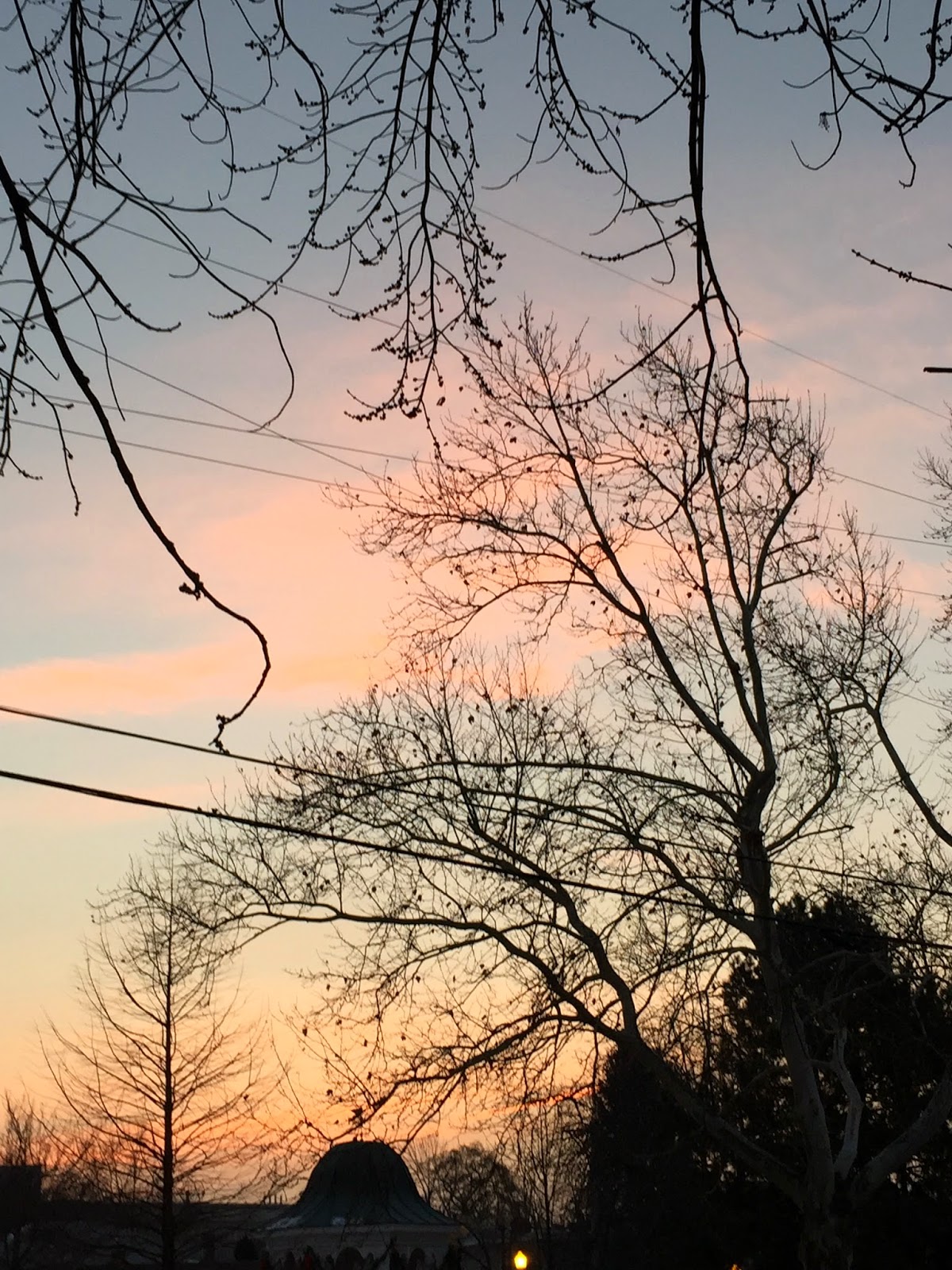
This morning, as I sat in the early morning dark sipping my coffee and checking Facebook, I was met with pictures of glorious sunsets from Australia and Nepal, and brilliant noonday clouds from England.  So of course I had to set down my coffee and go outside to photograph the delicate wispy-pink dawn clouds of Ohio to post.


My sense of who I am and where I live feels different. It's not the content of it that has changed, but the experience of it. I no longer feel myself living only here in Dayton OH, but rather on a whole turning planet. It's winter where I'm posting from, and in England and Finland and Croatia, but I'm also absorbing posts of the rich summer currently bathing Australia and Brazil. If it's breakfast time where I am, I am taking in images of noonday or sunset somewhere else. Before I go to bed, I may even be seeing images of tomorrow's dawn.

I can feel this expansion of self and sense of place happening through the common bond of gazing with wonder and appreciation at the sky and the clouds.  In place of the abstract concept of "one world, one human family," I now experience one shared delight in the different moods of the sky and clouds happening simultaneously around the planet in human hearts everywhere that enjoy it as much as I do.

It's quite lovely. A completely unexpected blessing.


Monday, September 1, 2014

Mushrooms and Monguette

Plants are amazing. They have the power to take up inert, non-living elements like minerals from rock dissolved in water, combine them with energy captured directly from sunlight, and assemble them into living/growing/ever-changing structures of great beauty and complexity. Poetically speaking, animals are just parasites, living off the hard work of plants, either directly by eating them or indirectly by eating other animals that ate plants. But it's plants that work the transformative magic, from non-life to life.

That, at least, is the rather simplified picture of the natural world that reflects the state of biological understanding I grew up with in the 1950s, before ecology and genetics came into their own in scientific circles. Now of course we know that it's actually a lot more complicated.

Consider fungi, for example. Scientists now classify them as neither plants nor animals, but instead as living beings comprising an entirely separate kingdom in biological taxonomy.  And their work is the opposite of plants. They are the decomposers, life forms that take apart the structures plants and animals create. And they are just as essential to a healthy ecosystem as the plants who bring life out of non-life.  They too--the decomposers--wield the power of transformation.  By disassembling the complex structures of no longer living plants and animals, they make the elements bound into those now-dead structures available again to be incorporated into new and different living beings. Sauteed mushrooms, anyone?

So what prompted these musings? Quick answer: two occurrences in the garden, plus the fact that today is Labor Day.

The garden first. About a week and a half ago, I took this picture of Mongo:


Never having been a foster-mother to a pumpkin before, I wasn't sure, but that really looked to me like a pumpkin approaching harvest time.  So the next day (last Tuesday), I seized the opportunity to consult with Emily of Mile Creek Farm (we are the downtown pickup point for their CSA). She said that yes indeed, Mongo was now harvestable, and their practice was to go ahead and harvest, not leave things sitting around. By that time, Mongo looked like this:


If you look closely at this picture, you will notice that by then Mongo's warts had turned entirely orange, and that I followed Emily's advice and cut Mongo's stem from the vine. Mongo is now adorning our kitchen table, along with some of Emily's sunflowers:


I'm pretty sure it was Thursday when I cut Mongo's stem, Friday when I brought him inside, and Saturday when I washed him off and gave him the place of honor on the table.  Sunday--yesterday--we had a good soaking rain for several hours, very welcome, as the garden had gotten quite dry.  Sunday afternoon, on impulse, I checked the pumpkin vine, and what do you suppose I found?


Mongo has a sibling! That little green bulbous swelling at the base of the flower is exactly what Mongo looked like at the same age.  Since it is impossible to determine the gender of a pumpkin, and since Mongo sounds to me like a boy's name, I have arbitrarily decided to balance things out and designate this one a girl.  I'm calling her Monguette, the French feminine form of Mongo.  Now it's a race against time. Today is already September 1--will there be enough growing season left for Monguette to ripen? We'll see.  Even if she doesn't ripen fully, I bet there will be enough time for her to become an excellent Halloween decoration.

The arrival of Monguette is the first of the two garden occurrences I referred to above. The second happened this morning.  As I mentioned, yesterday we had a good soaking rain. This morning when I went out to retrieve the newspaper, here is what I saw:


So lovely, so delicate, these little decomposers that sprang up overnight! Look in that second picture, how they seem to be embracing my birthday rock.

So here I am on Labor Day, the first Labor Day of my retirement, reflecting on mushrooms and Monguette. My birthday rock, symbol of my life so far, embraced by lovely decomposers. One structure of my life, the formal work of spirituality ministry, is over. Now it's time for the lovely decomposers to embrace that dead structure, disassemble it, and make its elements available for reassembly into something new and full of life--something perhaps as unexpected, untamed, and vigorous as the vine that gave me Mongo and Monguette.  Will there be enough time for whatever fruit comes to ripen fully? Who knows? But I bet there will be enough time for it to be a blessing in some way.

My job is to welcome both the embrace of the decomposers and the wild unruly new sprouts. It's a different kind of labor, but well worth celebrating on this Labor Day.


Sunday, August 10, 2014

Mongo and the Rock

Since I live in a 19th century town house, I don't really have a yard. My garden is a strip running around the four sides of my house, forming a hollow square from one to three feet wide.  In the last month or so, two new roundish objects have appeared in opposite corners of my garden. In the southwest corner in the back, a volunteer squash plant which appeared mysteriously in June has completely  commandeered the limestone walkway there. At first, when I just saw the leaves and flowers, I thought it might be a zucchini plant. But this is no zucchini! Meet Mongo:


A bit of online searching suggests that Mongo is a Knucklehead pumpkin. Mongo started out deep dark green, but in the last couple of days a bit of orange is starting to show, as you can see in the picture.  Despite the warty appearance, these pumpkins are perfectly edible.

Diametrically across from Mongo, in the northeast corner of my garden in front, an early birthday present has been installed, a lovely chunk of granite with streaky dark spots and flecks of mica and quartz. Meet Rock:


Landscapers call such objects boulders, but in this case that word strikes me as overkill.  It's really just a biggish rock. Michael and I had a lovely time last weekend visiting sand and gravel companies and landscape firms until we found a rock I like at a place that would deliver and install it (aging backs must be respected). 

So I found myself reflecting on Mongo and the rock. Unexpected (weird, gnarly) life in one corner; solid, steady rock in the other corner.

The Mongo vine is such an extraordinary outburst of life-force, with huge tough stems and gigantic leaves, that just appeared, unbidden and unexpected. And the rock was very deliberately chosen, brought in on purpose, and just sits there, connecting me both to my own roots and to all things that abide. Connecting: around here, the rock below the soil is limestone, because long before the dinosaurs this used to be the bed of a shallow inland sea. But where I grew up, in the piedmont of the Appalachians, the bedrock is granite, often breaking through the surface as real boulders and filling the streambeds as pebbles. Hence my granite birthday rock connects me to my roots.

Somewhere in between the sprouting of the Mongo vine and the installation of my birthday rock, I came to a decision. Last week I notified my directees and colleagues that I am retiring from spiritual direction ministry, after 30+ years. A number of factors came together into that decision, but one of them was surely a sense that it's time to embrace the new life springing up in unexpected shapes and directions--the Mongo factor. There were other factors as well, and the decision took its time crystallizing, but it did and still does feel right.

What comes next I will discover by going there. Some things already in place will now have room to flourish, and there is room for more to emerge. But what is clear is that as I face forward, it feels like I am standing on bedrock--hence my choice of birthday present.  And the gratuitous, outrageous vigor and lushness of Mongo are hope incarnate, enfleshed in a warty Knucklehead pumpkin.


P.S.: UPDATES:

The owl has been glazed and fired, and has found a home.


And the crape myrtles that I thought I had lost are in full and glorious bloom.


Thursday, June 19, 2014

Come Feel With Me

"I don't really want to watch any more of this," he said.  I agreed, so after only five minutes or so of the second episode of a streamed series Netflix had suggested to us we switched instead to a recorded episode of Big Bang Theory.  Ah, the joys of TiVo!


But somewhere in the back of my mind, I kept puzzling over this little episode. My husband's full comment had been, "I don't really want to watch any more of this--it's coarse." I agreed that I didn't really want to watch any more, but "it's coarse" didn't seem to fit quite right for me. It felt a little off, a little imprecise.

I've known more or less forever that my tastes in leisure/relaxation/entertainment experiences don't quite track with the cultural mainstream. I suspect that people have sometimes thought of me as a bit of a prude or a goody-goody, and I've always been a bit irritated by that, because it doesn't really fit my inner experience. But I've never been able to articulate exactly why it doesn't feel like a fit.

And then, some time after that little experience of switching from Netflix to Big Bang, a word popped into my head: empathy! Yes! That's the common thread: I strongly prefer books, movies, TV shows, activities that stretch and exercise and strengthen my empathy muscles.

They don't have to be deadly serious. They don't have to track perfectly with my personal value system. But they do have to engage, and ideally expand, my capacity for empathy.

I like things that give me an empathy workout. I feel good, in a way directly analogous to the "good tired" one feels after a physical workout, when I've had an empathy workout.


So I thoroughly enjoy Big Bang Theory, with its ongoing themes of the pain of feeling like the odd one out and the goodness and healing power of friendship.  I love Huckleberry Finn and Jane Austen and One Hundred Years of Solitude, so different in tone and setting, but so alike in keen and ultimately loving insight into human relationships.

Empathy workouts don't have to center only on human-with-human relationships. It can encompass human relationships with the rest of the natural world as well. For an experience of pure awe and delight, watch My Life As a Turkey.


And I could not fail to mention that most magnificent, many-layered empathy workout, To Kill A Mockingbird (both book and movie).


Foyle's War, Modern Family, Schindler's List, Donna Leon's Guido Brunetti detective novels--I'm sure you could name more.

I'm a sucker for history museums and archeological sites, places where I can feel a connection to lives lived long ago.

At a Tavern Dinner, recreating an 1840's tavern experience,
at Dayton's Carillon Historical Park.
 
I love art museums, where entering into an artist's perception of reality can expand my own, and especially public art, where that can become a shared experience building a sense of community.
 
What I don't like, and even fear, are experiences offered as entertainment that in fact serve to numb or deaden our capacity for empathy. It's not coarseness, exactly, but callousness that repels me.  I also dislike and fear addictive numbing-out presented as recreation, whether it takes the form of violent video games, gambling, substance misuse and abuse, or objectified sex.
 
What I value and seek is that empathetic feeling-into experience, whether somber (the D.C. Holocaust Museum, Of Gods and Men) or light-hearted (Strictly Ballroom, The Princess Bride).
 
Empathy, connection, community, fellow-feeling--call it what you will. This is what refreshes me, re-creates me. And I think it's not just me, it's our whole hyper-polarized world that could use a little more of it.


Thursday, May 29, 2014

Learning to Speak Clay


Two sessions of Handbuilt Pottery classes are now over, and I think I am starting to learn to speak clay.

And isn't it interesting that it should occur to me to say it that way? I can write and speak with at least reasonable fluency in two languages, with fair fluency in another two, and at least smatterings of three more. Language is my home turf.  It has always flowed easily for me and been a source of delight.

Working with clay, not so much. I enjoy it greatly, and I've been drawn to it for a long time, but that easy fluency isn't really there. Or maybe it's just that working with clay is such a different language family, compared to the Indo-European and Semitic families I have at least a nodding acquaintance with, that I am back to a baby's pace in learning this one.

[Pause while she savors the memory of her baby granddaughter's gurgles and squeaks in the background of phone conversations with her son.]

First there's just crying, then a whole repertoire of different kinds of crying. Then there are sounds deliberately made that are not crying. These go on for a long time and become quite varied before anything resembling a syllable emerges. And the syllables, in turn, become quite varied, and gradually assume the rhythms and melodies of the language the baby hears, while still remaining nonsense babbling.

Eventually, meaningful syllables, then words, then grammar and syntax emerge. Then you get your six year old grandson explaining his Magformers creations by saying, "The mating season is over, and now the pterosaurs have to defend the eggs from predators." (The kid watches a lot of nature specials on TV.)

[Parenthetical note: If you have kids on your gift list, get them Magformers. Heck, get some for yourself. Phenomenal toy.]

But do you ever finish learning to speak language? I don't think so. We can and do reach a state of effortless fluency, but there are always new words to learn or invent, new observations or insights to express, that keep stretching the limits of our language skills.

But back to clay. I think maybe these two sessions of classes have taken me through the repertoire of crying and varied non-crying sounds stages, with maybe some syllables and an occasional flash of fluent babbling emerging. I won't claim more.

So here are some of my gurglings and babblings in clay, and some of what I learned in making them.

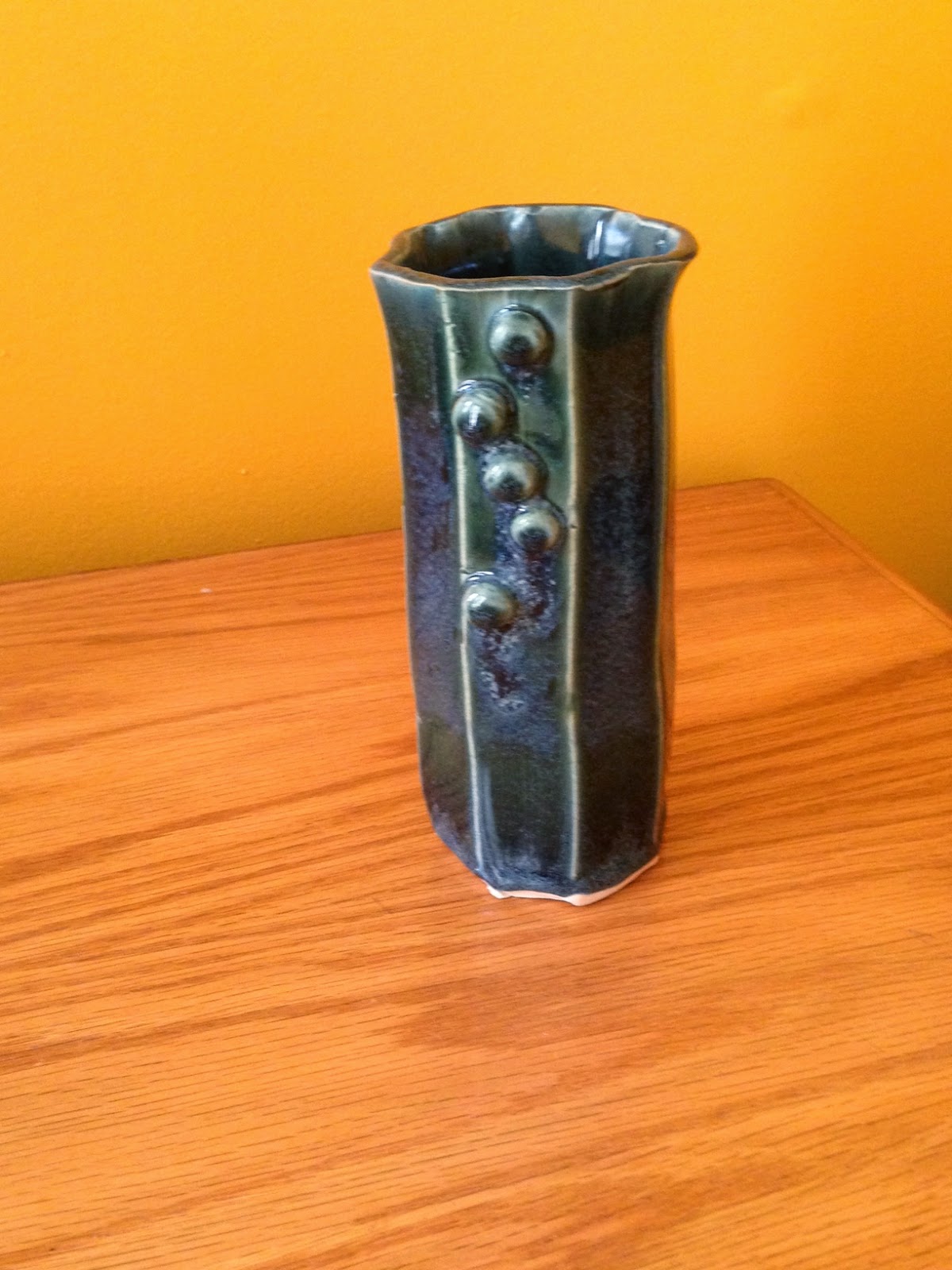
The little green vase (or planter or whatever) is the very first piece I made. It was a class assignment to make a slab-built vessel with curved sides, plus encouragement to experiment with textured surfaces.  I added feet, because I like footed things. It was just a whim. I still like how it came out. The slight texture was from a texture block borrowed from the teacher.

The lidded jar came not long after. Actually, the lid came first, when I had been experimenting with coil-built vessels and had some leftover coils. The teacher suggested weaving them, then commented that they would make a good jar lid. So I added the outside rim to the lid, and piece on the underside to prevent slipping. Then I had to make a jar to go with the lid, so I used my slab-building skills for that. The idea for the decoration was mine, combining a stamped small flower and freehand grass stems. My teacher clearly wanted me to glaze the piece, but something in me resisted--I didn't want to lose the texture of the design. So I wiped it with red iron oxide and left it unglazed. I was happy with the result.

And here we have three coil-built pieces, from which I learned that it is very easy to make bad-to-average coiled pieces, and very very hard to make good ones. 'Nuff said.


Several people in the class were making very practical pieces like bread trays and dishes with very regular designs, so I thought I should at least try that approach.


The piece on the right in the picture above is the result: very regular and rectangular, with a very regular, symmetrical design pressed in. It's fine, but I'm not particularly excited about it. The one on the left, though, I like much better.  I made it later, during the second session of classes, when I was becoming a bit more confident in my own style. Instead of cutting a neat rectangle, I just left the clay edges in the shape they had upon emerging from the slab roller. The textures I made with a jar lid opener, a texture roller, and a piece of seashell that was deeply eaten away by marine worms. I actually like this piece a lot. I wish the glaze color came out better in the picture. From these two I learned that I like irregular, abstract looking textures and shapes better than ones where it looks like I have completely imposed my will on the clay.

In between making the two dishes seen above, I did some experimenting with deliberately cutting designs into the clay, rather than just impressing textures into it. Here are two examples.


 I was very excited about these two pieces while I was working with the clay, drawing the trunks and roots and branches freehand, using a small scallop shell for the ground texture, and using the wormy shell for the leaves. But once they got glazed, I was underwhelmed with the result. More experimentation, maybe with added layers, is needed.

I have discovered that I am resistant to scrapping leftover clay. As with the leftover coils that became a jar lid, I try to find ways to use my scraps.


These soap dishes result from that impulse. I didn't think out the design ahead of time. I was just fiddling with some leftover rolled-out clay, trying to make it interesting, and realized that the resulting shape would work as a soap dish that would hold a bar of soap upright, so it wouldn't get all soft and squishy. I added feet, of course--I do like feet!--and in the first series, represented by the brown one on the left, I tried punching holes for water to drain. I discovered that the glaze would fill in the holes, so in the second series, represented by the one with the sort of octopus design on the right, I just made designs. 

I even like using other people's leftovers. This piece was made from a leftover bit of extruded clay that a classmate shared when she put more clay into the extruder than she really needed.


To me it has a kind of 1930s feel to it, an era whose design I have always loved. I'm particularly happy with how the glaze worked out on it--I'm nowhere near as far along in learning the language of glaze as I am in learning the language of clay.

And finally, I did some experimenting with making pinch pots, again discovering that it's easy to make bad ones, hard to make good ones.  This is the only one I've made so far that I really like.

Do note the feet. He has a third one in the back, because three are very stable.

Like all human beings, I love the feeling of competence, of mastery. But this adventure in working with clay has given me a chance to revel in the delights of being a beginner, even now late in my seventh decade. It's wonderfully refreshing. I recommend it.


Sunday, May 25, 2014

Sabbath Prayer

I attended Shabbat Morning Service yesterday. It was a Bat Mitzvah celebration, and the girl who was taking her place as a young woman in the congregation on this occasion designed and led the service, choosing which prayers we would all pray from the many possibilities offered in the Reform Siddur (prayerbook) her community uses.

Two of her choices stood out to me, so I thought I would share them here.

The first is a traditional Sabbath prayer, the Modim Anachnu Lach ("We are grateful"), but given a modern twist in this version. Think of a young girl, taking her place as a young woman, choosing this:


For the expanding grandeur of Creation,
worlds known and unknown, galaxies beyond galaxies,
filling us with awe and challenging our imagination,
    Modim anachnu lach.

For this fragile planet earth, its times and tides, 
its sunsets and seasons,
    Modim anachnu lach.

For the joy of human life, its wonders and surprises,
its hopes and achievements,
    Modim anachnu lach.

For human community, our common past and future hope,
our oneness transcending all separation, our capacity to work
for peace and justice in the midst of hostility and oppression,
    Modim anachnu lach.

For high hopes and noble causes, for faith without fanaticism,
for understanding of views not shared,
    Modim anachnu lach.

For all who have labored and suffered for a fairer world,
who have lived so that others might live in dignity and freedom,
    Modim anachnu lach.

For human liberties and sacred rites:
for opportunities to change and grow, to affirm and choose,
    Modim anachnu lach.

We pray that we may live not by our fears but by our hopes,
not by our words but by our deeds.

Blessed are You, Adonai, Your Name is Goodness, and You are worthy of gratitude.


The second prayer is shorter, but it really made me sit up and take notice:


We oughtn't pray for what we've never known,
and humanity has never known:
unbroken peace,
unmixed blessing.
No.
Better to pray for pity,
for indignation,
discontent,
the will to see and touch,
the power to do good and make new.


Way to go, Emma! Thank you for your inspiring leadership!